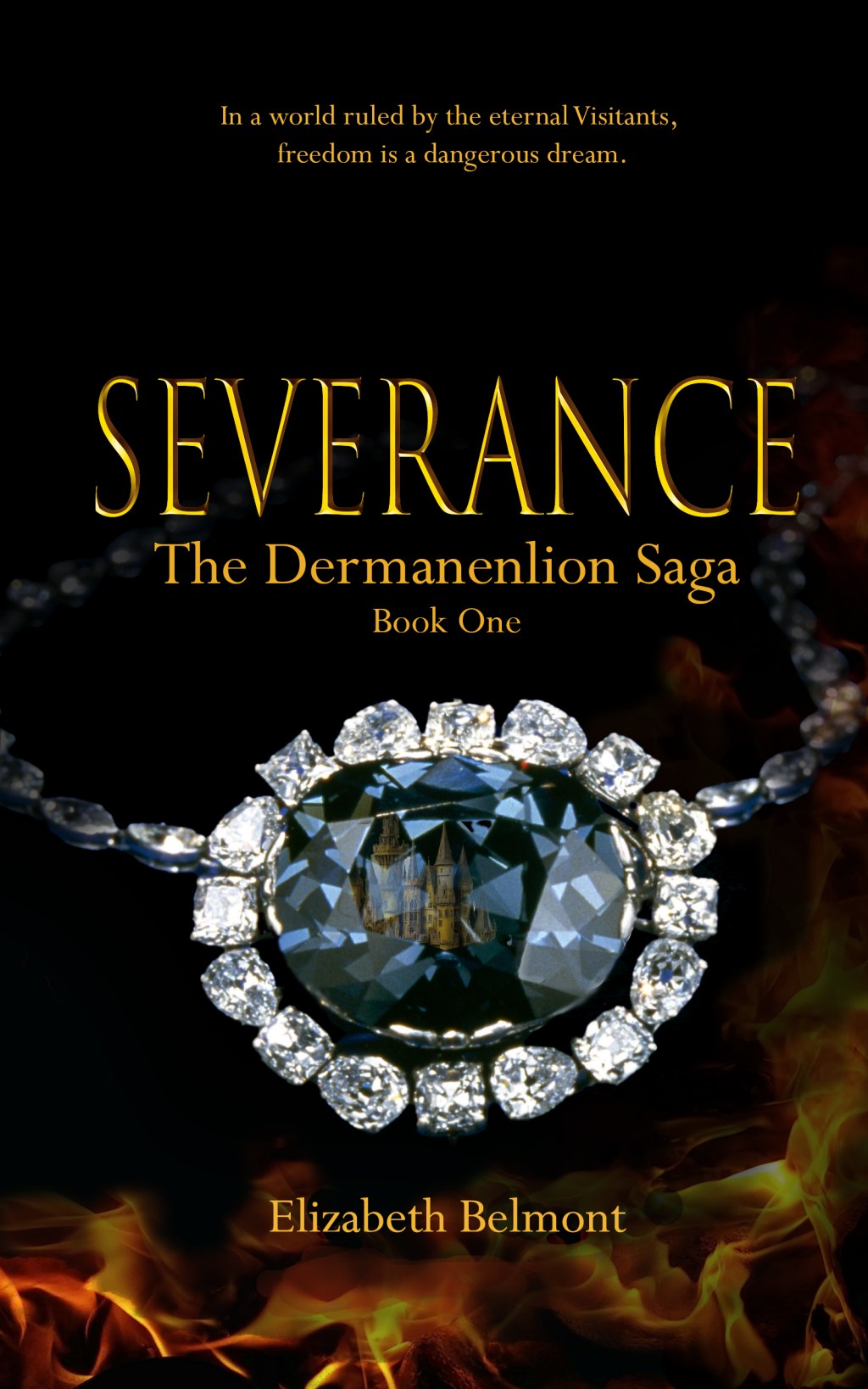
Dermanenlion (n): Of Mayan origin, meaning the end of the world, the apocalypse.
Literal Translation: “Life over cliff of death.”
Now I am become Death, the Destroyer of Worlds.
—Bhagavad Gita
—J. Robert. Oppenheimer, July 16th 1945
…because four times has man destroyed the world, and four times have the Gods rebuilt it. This is the Fifth and Last World, for the Gods are Dead and cannot build us a new one.
–Dadich religious tenet
Prologue
The old man’s garnet-colored eyes glimmered like jewels through the hookah smoke as he handed over the cylinder-shaped parcel. Esmund received it with a steady hand that did not betray the excitement that burned within him like his own personal sun. Were he a younger creature, he thought, this moment most certainly would have left him trembling.
This moment, the cumulation of centuries of searching. Of spelunking into mines or caves rumored to hold a trove of precious Fourth World artifacts; of picking through the ancient ruins of this city or that; of visiting one caravan after another after another, only to be told it had been lost, it had been destroyed, it was hopeless, no, it could be found in another caravan, just go to the west or the north or the south; No! He must cross an ocean to get it, an impossible feat! He must cross the Bad Lands, where only the Cadalari dared travel! Indeed, he had nearly given up hope and consigned the thing to the ashes as he had been advised!
How glad he was that he had persevered.
Resisting the urge to unroll the painting immediately, he traced the cylindrical contours of the ancient canvas with delicacy, savoring the anticipation of at last – at last! – beholding the masterpiece concealed within. With each stroke of his pale fingers across the rough canvas, he tried to imagine the master at work, painting the mysterious woman by candlelight in a time and place long forgotten by all but him. How he wished he could go back in time and see it for himself! Some said the subject was actually a self-portrait, the artist himself disguised as a woman – a worthy prank on the art world, indeed!
His tactile exploration was a dance of restraint, of bittersweet torture. He imagined that perhaps this was the wrong painting after all, and instead of the famous portrait he would open to one of ballerinas or waterlilies or even a melting face. Each moment of delay heightened the excitement, like the crescendo of a symphony building to its grand finale, and he hung in the exquisite tension between desire and patience for a moment longer, knowing the unveiling would be all the more glorious for the hesitation.
“Milord?” came the question. He looked up, shocked to see his Book-Keeper and the old man watching him questioningly, and even more shocked to realize that he had momentarily forgotten their presence completely.
“Is anything the matter?” pressed the Book-Keeper.
Esmund blinked at him for a moment before coming back into himself.
“No, Bertrand,” he said, feeling as though he had somehow been in a dream. “Nothing is the matter.” He returned his attention to the object in his hands. Delicately, reverently he unrolled the ancient canvas. Slowly it revealed itself to him with a sound reminiscent of dried leaves. It was brittle and slightly stiff – he reflected he would have to use one of his special preservatives on it as soon as he returned to Arlington – and as it opened to him like a door to another age it released the smell all ancient things held, dust and smoke and moldering wood, with a hint of linseed oil so faint only someone like him could have detected it at all.
It was her.
He released a sigh of satisfaction. “No, Bertrand,” he said again. “Nothing is the matter at all.” If he could smile in that moment, he would have, but it was something he had long forgotten to do.
His Book-Keeper cocked his head and exchanged a glance with the old man, who was absently toying with the curls of his elaborately styled beard. By his knee sat a colorful, waist-high water-pipe that was perfuming the air of the tiny vardo with the smell of vanilla flavored toback.
“She’s not much to look at, is she?” he asked with a grunt before taking a long, slow draw from the pipe. He tilted his head back and blew smoke rings at vardo’s silk-draped ceiling.
The Book-Keeper contemplated the painting. Esmund’s obsession with finding this particular piece of art had led Bertrand to expect something grand and impressive; instead, it was a mere portrait, rather small and almost monochromatically brown. The woman was no great beauty, either; she looked passively at the viewer with almost no discernable expression at all, save for the tiniest of smiles. He thought of the other portraits Esmund had in his expansive collection and the unexpected whimsy so many of them held – men yawning or pulling faces, boys seeming to climb out of the frame itself, cardsharps cheating at poker, drunks looking worshipfully at their glasses of wine.
This one was… boring.
And yet irritating.
“Why does she smile like that, Milord?”
“That has been the question of art connoisseurs and students for centuries, my friend. Is she bemused? Is she contemplating something? Is she holding back a laugh at a joke lost in time? We shall never know.”
“It vexes me, Milord.”
“All ladies have their secrets, my bachelor friend. It is part of their beauty. Or have you forgotten the appeal of a mysterious woman? I seem to recall one who once held you in her thrall.”
Bertrand scoffed.
Esmund reached into his robes, producing a roll of copper wire which he handed to the old man. “Your payment, as agreed,” he said with a gracious bow of his head.
“A pleasure doing business with you as always, sir.”
Esmund and Bertrand took their leave and exited the jewel-colored vardo through a narrow pair of painted wooden doors. All around them burst the sounds of the Cadalari camp, music and laughter and dancing and, above it all, the crackling sound of the Teslakoil erected at the heart of the camp’s great, colorful tent. They made their way through the rings of brightly painted vardos to where they had tethered their horses at the edge of the main tent.
As they mounted, Bertrand remarked, “Not all of us have had millennia to figure out the breed. Women, I mean.”
“To tell you the truth, I’m not convinced I have even now,” Esmund admitted. “I supposed that’s half the fun. And perhaps, the appeal of that painting I’ve got at last.”
Together, they rode companionably out of the camp and into the night.
Some say the world will end in fire,
Some say ice.
From what I’ve tasted of desire
I hold with those who favor fire.
But if I had to perish twice,
I think I know enough of hate
To say that for destruction ice
Is also great
And would suffice.
—Robert Frost
“Fire and Ice”
Part One
*1*
Adisha slept peacefully in her bed-nook, warm, dry, and cozy while the last of the summer storms pounded the thatch roof above. The heavy wool blanket was pulled to her cheek, a comforting cocoon. Two of the garden kittens slept curled at her feet, their purrs the lullaby which had sent her to sleep. The bed curtains were drawn closed across the entrance to her little nook, deepening the sense of sanctuary from the tempest outside. In the center of the cottage, a low fire crackled pleasantly in the hearth. Nearby, several more kittens slumbered in a purring pile of ears and tails and fur. Indeed, the entire village slept comfortably, and the river beyond carried on as it always had.
And then the world ended.
It ended as it always did, in a cataclysmic ballet of destruction and fire. The great towers of glass and steel were obliterated by a white light and then devoured by the maw of an insatiable tempest of smoke and flame that roiled over the landscape, billowing and churning itself into the haunting shape of a towering mushroom.
And in the midst of this cataclysm, she, too, was consumed, as she always was. Her anguish was visceral to the point of primordial as she felt her skin blister and crisp like pork belly, then pull away from her muscles in blackened strips while her blood boiled in her veins. It felt as though she burned for all Fourth World, the pain of billions of souls encapsulated in her screams. But as always, by the time her bones began to burn, she could no longer feel anything but horror.
Body vibrating with adrenaline, she pushed aside the curtains shrouding her little bed-nook and peeked out. The cottage lay silent and – save for the kittens – deserted; her pa’pere’s rocking chair was empty by the fire and his bed unoccupied, the curtains open. Her frightened heart sank a little bit at the discovery, because his silent presence would have been a comfort. She guessed he must still be at work. With a sigh she slipped out of her little nook, nestled into the thick mud-and-timber wall like a large cupboard. Her woolen blanket lay abandoned on the floor, having slipped away when she jerked awake. Now she picked it up and gathered it around her like a protective mantle.
The storm continued its assault upon the earth, pummeling a relentless tattoo against the thatched roof and transforming the little streets and pathways outside into mud. Despite the sanctuary offered by the cozy cottage, its earthen walls were unable to shield her from the tendrils of dread that crept down her back in the form of cold sweat. She shuddered involuntarily, the tremor coursing through her small frame, yet she scolded herself for succumbing to fear at all. It could have been worse, she reminded herself. Some nights brought tormented screams; others, tears that flowed like the rain outside. Tonight, however, she merely awoke trembling, a silent testament to the horrors that still lurked within the recesses of her tired mind.
She went to the wash stand and splashed some water on her face, then padded across faded wool carpets and reed mats to the circular hearth in the center of the cottage. She grasped the wooden fire poker and jabbed at the smoldering coals irritably as though they were the cause of her torment. The embers reminded her of the burning cities from her dreams. She shuddered and turned away.
The burning cities of Fourth World….
She stalked towards a window and peeked through the shutter slats into the storm. Other dwellings glowed warmly through the veil of rain, the golden flicker of candles or low fires peeking through the edges of closed doors and fastened windows. Beyond them all a single point of light hung high in the air like a star: it was the window of a distant, high tower. Within that ethereal glow was Adisha’s father, no doubt bent over some ancient tome with Lord Esmund, painstakingly restoring it or perhaps debating the philosophy contained within the fragile, time-worn pages. The light seemed to bridge the distance between her and her father, connecting them by a fine thread of gold even as they were parted, and Adisha found it gave her comfort. When the light finally went out, her pa’pere would come back home.
Adisha glanced towards his vacant expanse of bed, a large postered affair with a canopy and heavy curtains that cascaded like a veil of secrecy. Set into the wall over the head of the bed was a small cupboard with a precious secret inside: a small collection of ancient books. These rare treasures had been brought from the pale stone walls of Arlington Castle, gifts from Lord Esmund to his valued Book-Keeper. The delicate, leather-bound volumes bore the patina of great age, their covers adorned with faded hints of gold and other faint colors lovingly woven into geometric designs, flowing plants, or delicately rendered people. Each page whispered of a forgotten era, a time when knowledge was revered rather than feared. Safe inside their little cottage, Bertrand would often tuck his only child beneath his arm and open a heavy volume across their laps, reading to Adisha tales of heroes and accounts of history, biographies of great people and flights of fancy. This was a secret ritual shared only between father and daughter and performed with the shutters closed, for were it known in the village what they were doing, the penalty would have been death.
And when Bertrand was gone, Adisha would occasionally slip a book from the shelf and go sit by the fire. Not for nothing was she a scholar’s daughter, and she had taught herself to read from a lifetime of sitting at his arm. And yet this talent of hers was just another secret – like her dreams – she dared not share with anyone, even her pa’pere. It was dangerous enough that he could read, but at least that was done with the knowledge and encouragement of Lord Esmund. Adisha did not care to find out if their Visitant Lord’s generosity and indulgence would spread to her.
Returning to the hearth she gave the coals another jab and added a log. Sparks swirled upwards in a glittering cloud, a miniature of the pyrocumulus she had just seen in her dreams. The low fire let off the only light in the dwelling tonight, a comfort she sorely needed, a golden hug to stand in for the one she couldn’t have from her father just now. She jabbed the fire again. She asked herself now the same question she asked herself every night: what had she done to be cursed like this? Did her Cadalari blood so displease the Dead Gods they cursed her from their ancient graves?
She returned the fire poker to its place with the other hearth tools, its slender form standing upright in a tall, narrow basket woven long ago by her mother from river reeds. A sweeping glance around the simple dwelling reassured her that, save for the echoes of her unsettling dreams, everything remained as it should be. The cabinets – mere niches embedded in the thick walls, sat with their little doors tightly closed. The dining table, now cleared save for the simple fair of bread and cheese covered in a napkin, sat to one side of the little cottage. Above the dining sideboard, the pottery dishes gleamed in the flickering firelight, each vessel and piece aligned neatly with its neighbor along their recessed, open shelves. The curtains to Bertrand’s bed were drawn back to one side, revealing the yawning depths beneath the canopy like a cavern. The shutters were secured against the onslaught of the storm, their wooden slats a barrier against the tempest’s fury. Her hand brushed against the door latch, ensuring it was steadfastly closed. Although she understood this was a useless piece of ritual born purely of her unease, she found comfort in the familiar motions, restoring a sense of control and security to her cozy little world. The familiarity of her home, the touch of the worn furniture beneath her trembling fingertips, were always a reliable solace following the strange and harrowing dreams. It was a tangible reminder of what was real, and what was not. Order against chaos.
Satisfied, she crawled back into her little nook and pulled the curtains so that just a slice of firelight fell across the bed and climbed up the smooth dirt wall in a golden bar. She pulled the covers up to her neck and turned over so she could stare at the flickering slice of light and wait for sleep to capture her.
A tapping woke her. She crawled out of bed and went to the nearest window, pushing the shutters open to greet an enormous crow, his feathers shining in the sun like an obsidian rainbow. Archimedes, she called him. He cawed and flapped his wings impatiently, as if to call her attention to the world outside the dark cottage. The taint of the nightmares could never survive in the sunlight, and today was a beautiful day.
The warmth of summer had begun to wane and a delicate crispness suffused the morning air, promising autumn. The sun was a bright jewel set into a clear, brilliant sky. Birds, not yet ready to migrate for the winter, twittered in the trees and the breeze carried with it the sound of beavers hard at work on the river. The vibrant leaves in the surrounding trees whispered their secrets to each other, the breeze sneaking in through the open shutters and inviting her to come outside. The day was more than beautiful – it was ideal, and staying inside would have been blasphemy against the Dead Gods.
“Want,” the bird demanded. “Want!”
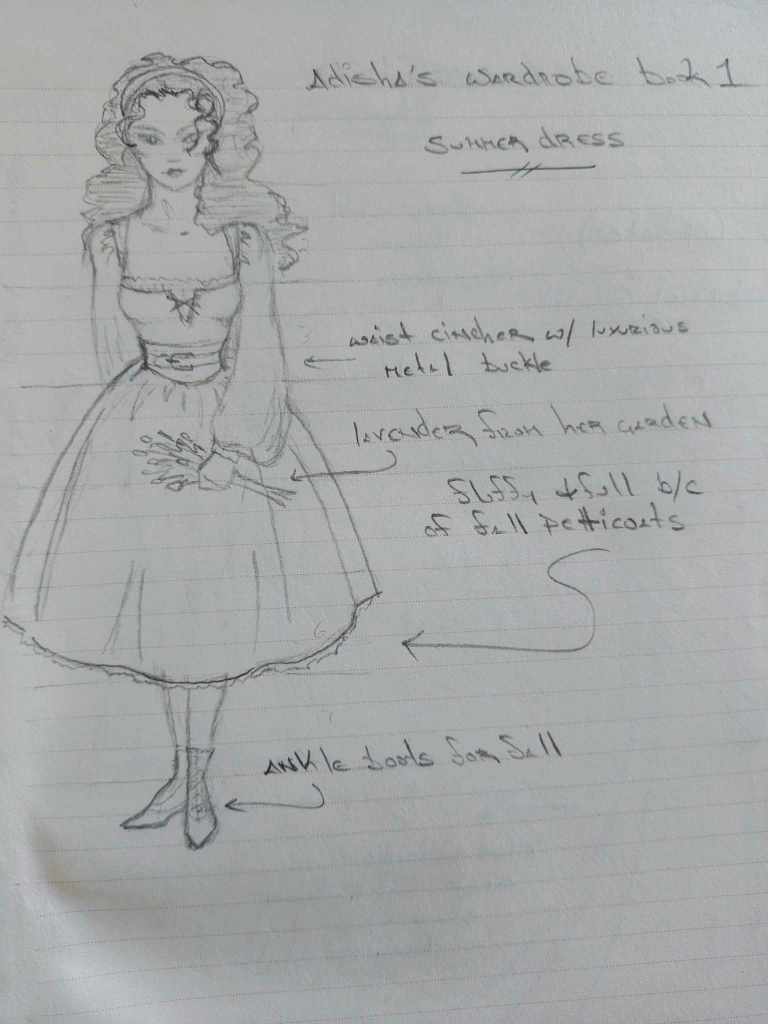
Adisha tore a crust of bread from the loaf on the table and offered it to the ebon bird, who snatched it from her fingers and placed it on the windowsill so he could peck at it. She left the window open – it would not bother her father, who had returned and was now slumbering deeply behind the heavy bed curtains. Adisha dressed. Over a simple cotton shift went her daily dress, a sleeveless dark brown pinafore made of coarsely woven cotton with a square neckline and three little buttons at the bust for decoration. The skirt was full and hung just below her knees. She adjusted the bodice with laces in the back and buckled a thick leather cincher about her waist. The breeze whistled through the cottage, tousling her hair and reminding her that soon she would need to start adding petticoats beneath her skirt. Already she had packed her summer slippers away and put on the low-heeled ankle boots she would wear until next spring. She tied her thick black curls away from her face with a ribbon and checked her reflection in a piece of ancient, shiny metal which she kept propped on a shelf. Real mirrors were rare and expensive, but she made do nicely with this relic she had found in the ground years ago. When she had touched it, she saw that it had once been a part of a sort of sleek, metal carriage that had gone hurtling down a smooth black road at incredible speeds. It was a relic of Fourth World, and, like her dreams, relics showed her what had been in the moments everything had been destroyed. Like all relics, the brief visions ended in a flash of light or a ball of fire, and Adisha found herself screaming. When she handled this piece, she wore gloves or picked it up with a cloth.
Satisfied with her appearance, she hooked a small basket in the crook of her arm, stepped out of the cottage and closed the rough door behind her.
The village of Wash was nestled snugly in a fork of Swan River, bordered by forest to the north and the swamp to the south. Arlington Castle perched on the western heights across the river, paternally watching over the fields and little cottages which made up the seat of Lord Esmund’s Lordship. Today the village was bustling. Chancel, the jewelry-maker’s son, had brought his work outside, as had the rest of the village. The porches were occupied by women tending to the daily chores of washing, sewing, spinning, or carding. Vegetable patches were being tended and the dirt paths through the village were full of people running errands or visiting. The shops, all lined up in a neat row by the banks of the river, had opened their windows and doors to let in the weather. Muskrats, geese, rabbits, ducks, and small game birds hung in the doorway of Lionel Attor’s butcher shop. Next door, candles, made from the tallow of the butchered animals, swayed from the ceiling of the chandler’s shop which was run by his wife, Limeira. The barrels in front of the fish-monger’s cabin were dripping with water and brimming with the day’s catch, fish flopping and eels swirling hypnotically. Crabs crawled over each other in a shallow crate and clams stayed tightly clamped in a wide wooden tub. The cobbler, Antonio Theon, sat on his front porch, lacing the leather pieces of a boot together with sinew. Beatrice, wife of Tom Morelle, sat outside her pottery shop, using her foot to pump the wheel that whirled between her legs. From between her skilled fingers a soft, shining vessel rose and took shape like a living being. Her son was busy carefully filling a brick kiln with a batch of mugs and plates. Markus Smithson, the tool-maker, had rolled the woven reed mats of his shop all the way to the roof, making his store into an open, airy pavilion. All manner of tools hung around him: hammers made of wood or hide, axes with smooth, stone heads. Daggers with blades of chipped stone filled a bin, and the table was littered with glittering shards from their construction. Arrows, bundled by the dozen, stood in hanging baskets that swayed in the wind. Most had fire-hardened black tips which had been filed to a razor point. The finer ones were tipped with stone or even glass.
There were no metal weapons, but Adisha knew that once, all of those items would have been made of that forbidden material. Metal, like the written word, was illegal. Without metal, humanity could not wage a massive war and could not reforge the bombs which had destroyed Fourth World.
Women and children worked busily at the communal tobacco barn, binding together the last of the harvest so the leaves could be hung to dry. The sound of clucking hens, bleating goats, and grunting pigs filled the air from behind some of the little homes. Even the doors and windows of the distant castle had been thrown open, and, if one looked closely, they could spot a dark, robed figure sitting on the tower’s highest balcony, relaxing in the shade of the eaves.
The only taint to the day was the clerics, as per usual. Cloaked in red, orange, and black to evoke the colors of the nuclear fires, they roved among the villagers and screeched in hysterical tones about how the unholy trinity of reading, writing, and war had ignited the flames of humanity’s downfall time and again. Their faces were painted in ash. They grimly intoned the same phrases they always did.
“Ignorance is our salvation. Knowledge breeds Dermanenlion.”
“Forge not they mind, for the smith’s hammer begets only ruin.”
“In the absence of learning, peace reigns eternal.”
While other villagers seemed to find comfort in their constant preaching, it always made Adisha’s insides quiver. She thought of clerics she had read about in her pa’pere’s books from Fourth World, and how they stayed in special buildings where people went to hear them preach if they so desired. These clerics had no such building, and instead roamed the villages at will, appearing and disappearing like clouds with no seeming point of origin. They would harass a village for sometimes only a day, sometimes for weeks before melting away and eventually being replaced by another set… or maybe it was the same set. It was hard to tell with the makeup.
“No mercy for the apostate!” One shouted in her ear. “Punish those who embrace the forbidden arts!”
Another, spotting Adisha’s distinctive Cadalari features, came swiftly over to join in.
“Let the heretic’s screams be a hymn to our righteousness!”
“Witch.”
“You shall burn for living outside of Visitant law!”
Adisha pushed away from them, shaken, and darted between some nearby buildings to escape. She threw a glance over her shoulder to see if they were going to follow her; they were not. They had returned to roving among the shops. She kept running, making some random turns, and wondered for an insane moment if they possibly knew of her father’s secret collection of books. No, she thought, picturing the metal lock on the little cupboard, that was impossible.
She leaned up against the side of a building and took a steadying breath, feeling it hitch in her chest for just a second. She looked down at her hands to find them shaking. Shaking, and the offensive, pale color of milk. She cursed that pale skin, and how it had attracted those clerics right to her, allowed them to identify her as other, as heretic… as Cadalari. As a young girl she had often rubbed dirt into her arms and face, hoping she could stain her skin until she matched the rest of the villagers – all it had ever done was guarantee she was forced to bathe when she went home. And even though she was almost to her seventeenth birth season, she found the urge to kneel in the dirt and scrub it into her flesh nearly overpowering. She pushed it aside, vaguely wondering if anyone was ever truly free of the child they had once been.
Calmer now, she patted her hair down and smoothed her skirt before stepping from between the buildings into another pathway. She decided to escape the villagers – and clerics – for now by going into the woods to check her snares and hunt for mushrooms and berries. A barrage of excited younglings darted from a vegetable patch, playing a game of hide-and-seek. Four puppies brought up the rear, yipping with excitement. Only one of the puppies was kaiju; a stumpy fifth leg projected from its left hip and was scrabbling at the air in time with the other four. She wondered why it had not been drowned at birth- the kaiju were bad luck, the lingering punishment of the Dead Gods for the destruction of Fourth World. The younglings jostled past her, giggling, and then scampered away, disappearing behind houses and into the trees. One boy slipped smoothly beneath Chancel Fallare’s wooden porch. The jewelry maker did not look up, but Adisha could see a smile tug at the corner of his mouth.
One of the indulgences which Lord Esmund granted to his people was the allowance of a village jewelry-maker who worked with metal. Since the death of his father last winter, young Chancel Fallare had taken over the trade. He was only just completing his first summer as jeweler, but he had been taught from the cradle and had great talent. Word of his fine work had spread quickly – already the prosperous individuals from other towns were soliciting The Lord for permission to trade for Chancel’s wares. A jewelry maker was scarce enough, but one who worked in metal was a rare thing indeed!
A few villagers idled by his workbench, watching him with interest and, today, a bit of envy. They all had a few of his father’s pieces. There were necklaces made of glass beads, carved wooden earrings, pendants or bracelets for the more prosperous women made of wrapped metal wire found in the ruins. Being able to wear metal was a status symbol indeed! Thanks to the prosperity of her husband, Messes Attor had the largest jewelry collection of all and was sure to wear as much of it as possible each day.
But the metal Chancel worked today was something they had never seen before. Chancel called it copper. It glowed in the sunlight, a rosy shade of gold that matched the thick sheaf of hair hanging in his face. He had several thin wires and was painstakingly tooling them into elaborate knot work. Ever-so-often he would toss his chin-length hair out of his face but his vivid green eyes never left his work, not even when the child crawled from beneath the porch and peeked over the edge of the work bench. The villagers watched with fascination and chattered amongst themselves. Entranced by the fine work of his long, skilled fingers, Adisha found herself drawn into the crowd. For a moment her mind slipped back to last night’s nightmare and she registered the contrast between the humans of Fourth World and the Dadich of Fifth World. Unlike the tall, diverse people of Fourth World, the Dadich tended to be tawny, small, and rarely fat. Chancel’s copper-colored hair made him a rarity among the Dadich. Adisha, too, stood out sharply, but whereas Chancel’s differences had made him popular and sought-after, hers only served to emphasize her otherness among the villagers. Her milk-white skin, black hair, and vibrant purple eyes marked her as her mother’s daughter; her mother, the Cadalari witch, a blasphemer, a user of technologia and of the written word. An outsider.
Self-consciously, she tucked her hands into the pockets of her skirt, trying to hide her difference as much as she could so no one else would hassle her, but at the moment everyone was interested in the beautiful metal before them and the elegant ring Chancel was fashioning from it. No one cast her so much as a second glance.
“Where did he get such metal?”
“Who can barter for such a thing?
“Is it an order for Our Lord?”
“Is that for Messes Attor?”
“It’s for Mishka, it must be.”
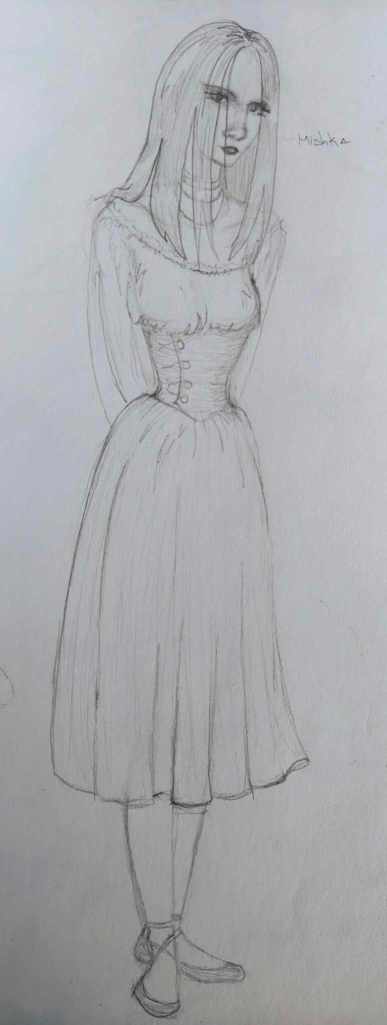
Any one of them could have asked the jeweler these questions themselves, but gossip was the principal form of entertainment in any village. Getting definite answers would have spoiled their supper-time talk; each of them would much rather pass theories alongside the bread for at least one evening. And the majority of the whispers which Adisha heard centered around Mishka, daughter of Lionel Attor, the small girl who stood timidly off to the side at Chancel’s elbow. Her hands were clasped behind her back, her unbound hair falling partially over her face and one shoulder in a sable cascade. She was watching his work intently, even though she kept her distance.
That was how Adisha always remembered her – at a distance, watching everything from behind her hair.
Watching him, especially.
The boy from beneath the porch was now examining the jeweler’s tools with the unabashed fascination that only children possess. On tiptoes, chin propped on the edge of the table, one curious hand fingered tool after tool before reaching for the rosy metal wires that lay spread on a soft piece of leather. The copper threads had been bundled in a cracked black casing of a material which Adisha had sometimes found in the fields or swampy ruins. Chancel had cut through the casing with his glass knife and split it open like a bean pod. The casing now lay curled, forgotten, to one side of the table. There was continuous white printing down the side – “Cobra Cable X-Flex”- followed by a string of numerals. Beside the black casing was more of the metal thread, but this was a powdery green instead of the rosy gold color that was forming into twists and knots beneath Chancel’s fingers. Several small sections had been snipped and were soaking nearby in a mixture of vinegar and salt, waiting for Chancel to polish them to a shine. Adisha had seen the same powdery green before in the ruins but had no idea that such beauty lay beneath.
The curious little boy had now set about asking the sorts of questions which would spoil the nosy hens’ hope for dinner table speculation. Chancel, however, seemed quite happy to play by the ladies’ rules and was maddeningly vague in his responses.
“But what’s it for?” the child asked.
“It’s time for me to take a wife,” he responded, simply.
“But who?”
“Someone special.” At this, Mishka blushed furiously. She ducked further behind her veil of hair but it could not hide her pleased smile. Adisha felt a sudden pang in her chest. She resented that pang bitterly.
“But who?” the boy pressed.
Chancel, his talented hands never pausing, smiled a bit. He was enjoying the game. “You’ll find out at the festival.”
The youngling looked around conspiratorially, eyeing the crowd. “C’mon,” he whispered, “Couldn’t it be, like, a secret?”
The craftsman smiled wider. “It is a secret. It’s tradition, you know! Someday, you’ll get your own secret to keep, and your own festival to tell.”
“Oh.” The boy was crestfallen for only a moment before his natural curiosity took a different tack. “But where did ya get it?” he asked, reaching for a thick copper thread.
Here, finally, Chancel paused. He leaned towards the boy and said archly, “From the ruined city in the swamp!” His comment had the desired effect. The boy’s eyes got large and there were a few gasps and murmurs from the crowd.
“But that place is haunted!” the boy cried. “It’s bad luck, Messior!”
“Not for me, it’s not,” he replied. “Or for her, either.” He made to return to his work but then seemed to notice Adisha for the first time that day. He caught her eye and winked through his gleaming hair. Adisha felt as though a bucket of ice water had been dumped on her head. Forgetting all else, she turned on her heel and left the crowd.
Raging thoughts and clashing emotions blurred the sight of the people and dwellings she passed. She did not note her surroundings. The day’s chores and errands had been forgotten. She knew only that she felt smothered. The familiar sights of the village had become cruel and weighty and she needed to get out. And so her feet carried her automatically while her mind was miles away, trapped in years long past. She hurried, and hurried far, not realizing that she could have run to the ends of the earth and it would have done her no good, for it was not the village and the people or even Chancel that she ran from, but only herself. Herself, and feelings she wished she could scoop from her chest like the insides of a pumpkin. She wished she could cut him from her chest, and her mind, and her heart.
He had winked at her. Of all the infuriating, roguish, childish gestures. He had winked at her, Adisha, whom he had not bothered to speak to for some years, while his bride-to-be stood at his very elbow. After years of looking right through her, as though the childhood they had shared had meant nothing, after years of walking right past her with the attitude of a cowed dog, now he felt he had the right to tease her like the rest of the village did. As though the memory of their childhood together was nothing more than material for jest.
And what a childhood it had been. Her memories of it, as painful as they had come to be, were still as bright and fragrant as ever. Seasons full of playing in the trees and the village – of hiding beneath the skirted and festooned tables at each seasons’ festivities. Stealing treats from the banquet table and gorging themselves on so many sweets that they could hardly move in the morning – of afternoons sitting on the banks of Swan River and watching the sleek beavers at work building their dams, or enjoying the beauty of the numerous majestic white waterfowl which gave that river its name – of nights spent sneaking out of windows to tell ghost stories in the forest. And endless, endless summers spent within the swamp, and of the mysteries which it revealed only, it seemed, to them.
And it was here in the swamp, their sacred space, that she found herself once again. Without intention her feet had carried her to the shady, eerie beauty of their shared paradise. Her and Chancel.
At the fork of the great river, forest gave way to cypress, moss, and even marble if one were willing to go so far in. Few would, for they feared the ruins more than the deadly kaiju gators that lived there. The ruins rose from the swamp and the muck majestically, shrouded in moss and covered in lichen. Narrow towers, large blocks, fragments of statues – it was easy to see why people were uneasy about a place in which shattered stone faces peered eerily from the trunks of the trees which had consumed them over the centuries, or where thick vines hung decorously from the metal skeletons of structures which had been of unimaginable size – bigger, even, than Arlington Castle! Here was the greatest remnant of their ancestors’ past, the crumbling ruins of a great city of Fourth World – a reminder of all that humanity had once had, and squandered. The Dead Gods had left it behind so the lessons of the past may serve as a warning for this, the Fifth and last world. Five times had they rebuilt the world, and now they were dead. There would be no Sixth World. Fifth World must be cared for and protected. And so the lessons were remembered and heeded. And the place shunned.
Here in the ruins of Fourth World sat Adisha, curled upon a lichen-encrusted chunk of white marble with her arms wrapped around her knees. Overhead arched the rusting, vine-covered ruins of what had once been a great dome, sunk lopsidedly into the mud. Cypress rose between the metal arches; in some places the thick trunks had slowly grown around the metal-work, making it seem nearly organic. Grey moss hung in swaths and garlands. What metal showed from beneath the heavy growth was rusted, eaten, warped, and in some places melted, for it had survived the Fourth World fires. Here and there a few weathered, cracked, and crumbling marble pillars jutted from the mossy earth, giving the crude suggestion of a wide ring which loosely encircled the wrecked dome. Beneath the crooked center of the dome was the gigantic statue of a woman, green with age and sunk to her chest in the muck. She had once perched atop the dome, but sometime during the passing millennia had fallen through. Adisha knew this because she had seen it, just as she knew the entire dome had once crowned an expansive white building that had seemed made entirely of stairs and columns. A narrow green lawn had stretched before it to great lengths, ending in a delicate white obelisk which Adisha had also long ago found. The lady’s features had been softened and distorted not by time but by the same fire which had twisted the arches of the dome and brought it crashing to the earth. Although the design of the elaborate headpiece which she had once worn was melted beyond distinction, the stars on her brow were still clear, and so were her eyes. She watched Adisha passively, as she always had.
Images floated throughout her head as they always did in this haunted place. This had once been a great center of Fourth World, a place where many rulers had governed their expansive kingdoms. Although she sat beneath the trees, dappled in sunlight and listening to the melodic sounds of swamp life, she saw herself surrounded by grand white hallways and tall statues. Important people in jackets swarmed past her. They carried leather satchels in their hands. They talked quickly and walked even faster, for there was always a great deal to be done. Adisha did not mind the echoes of the life which had once flourished here so long as she was not plagued by the fireball which had consumed it. Today, she would be lucky. Matters far closer to heart took precedence over her visions.
How many days had been passed here, in the ruins, beneath this very dome? As small children they had climbed the foliage-covered arches, racing to see who could get to the center first. In those days, they always came home covered in rust and grime. The jagged metal arches had torn many a dress! As they had grown older, the monkey games were replaced with more reflective activities. She remembered so clearly the way his strawberry-gold hair shimmered in the tiny spots of sunlight that snuck through the canopy.
How many times had he appeared at her window late at night, lifting the reed blinds and tossing acorns at her until she awoke? Those nights were filled with firelight and ghost stories in the nearby woods. Adisha’s stories had always been the favorite. It was easy for her -she just told of her visions. How often had they raced through the village, playing hide and seek just as the children of today? Hiding in trees and beneath the porches of the shops or larger homes. How many times had they snuck into Messer Sanders’ chicken coop just for the joy of frightening the birds? How many times had they opened the butcher’s pig pen, just to watch his fat belly jiggle as he chased the animals through the village?
“Gives a new level of meaning to ‘bringing home the bacon,’ doesn’t it?” Chancel had chuckled.
There were other children, of course. Adisha, as a child, had been quite popular amongst the village younglings. They begged her to tell stories; an invitation to join what became known as the “Midnight Society” was highly sought after. Late at night, Chancel would round up the favored playmates before he poked his head through her window to summon her. What followed were hair raising stories served up with freshly popped corn around a fire. Sometimes someone would even pilfer butter to melt over the top.
Younglings are by their nature inquisitive and open little creatures. Prejudice is not natural to them – it is planted there by adults, a vile, thorny flower that must be carefully cultivated and nurtured until its tendrils have grown and tainted every part of a person’s soul with their poison.
The worst part of the poison is that it is pernicious; it must be passed on to all within its victim’s sphere of influence or it is not satisfied.
The younglings in the village had not yet learned to fear Adisha. Indeed, they loved what she could do. If one of their pa’peres had tilled up an interesting something in his portion of the fields, they brought it straight to her to find out what it was and where it had come from. Mostly, it was fragments of the buildings that had once stood on the lands their village now occupied or chunks of the smooth black rock of which Fourth World’s roads had been made. Household objects emerged now and again, like a piece of petrified wood that had turned out to be the handle of a metal cooking pot. When she held it in her hand, she saw what could only be a kitchen, full of sleek and strange contraptions which gleamed and shone. A woman was making a stew, and Adisha could hear her humming quietly and smell the fragrant herbs which she was adding to the chicken stock. She knew that the woman was waiting for her husband to come home with their children.
The best things, however, were always found when she went digging, like the shining piece of metal which she kept at home, or bits of melted glass or other oddities. It was as if she were drawn to them, some sort of strange magnetism that transcended millennia, calling her, the one who would remember what it had all been.
During the dry seasons of fall and winter, when the water was low and the ruins were surrounded with emerald moss instead of mud, those children who were brave enough to follow into the swamp were rewarded with vivid descriptions of the great white city that once stood there. Adisha told of fast metal carriages that moved without horses and metal birds that soared through the sky with people riding in their furnished insides. She told of pictures that moved and talked, and of glass candles that lit at the flip of a switch and lasted for entire seasons. She spoke of small devices that allowed people in distant kingdoms to talk with invisible lines which were activated by just the touch of a few buttons. Like the fire-bugs that came with warm summer nights, everything in Fourth World lit up and glowed. These were great wonders beyond their imagination, the knowledge which had created them forbidden forever by the Lords. Yet Adisha saw them all, and her playmates saw them through her.
But the fire always came. At the end of every vision, coming to wipe the wonders away. To melt them, to blast them into the farthest corners of memory, to consume them and leave only ash. The inferno, and the agony, and the death. Time and again she watched Fourth World be consumed, and when it was too vivid, she forgot where she was and screamed as though she burnt along with the people in her visions.
It frightened her playmates, just as much as the earlier parts of her visions delighted them.
And their parents did not approve of her skills. Witchcraft, they said. One by one her companions disappeared, until it was only her and Chancel.
And Mishka. Always Mishka. Sitting just outside of the firelight, hovering just to the side of a tree, always happy to be found when Chancel was “It” at hide-and-seek. She said very little but watched it all with her pale brown eyes, like the melted green statue which watched Adisha now. Until eventually she, too, was forbidden.
It mattered not to the book-keeper’s daughter and the jewelry-maker’s son. Sneaking away from their chores as often as possible, they spent more time in the swampy ruins than in the village itself. Sometimes Mishka, too, would escape from her mother’s watchful eye and join them, and they would while away the hours together; talking, exploring, digging. Occasionally they would see lizards with extra or missing legs, or get close enough to the beavers to see that they had a superfluous eye or a clubby foot. Whoever spotted the first kaiju of the day got to play at being Lord Esmund, and Lord Esmund got to decide what they would all do for the rest of the day.
The questions and lectures her two companions received about the abandoned chores were endless; Adisha, on the other hand, was rarely bothered since Bertrand tended to work through the night and sleep during the day. Eventually Mishka stopped joining entirely, yet Chancel kept coming even against his father’s wishes, continuing to sneak away during the afternoon or summoning her from her window at night.
And this memory…. This memory she fought the hardest. She tried to focus on the visions of the white city and the men in their strange dark jackets, but this crept in all the same. That beautiful fall day, so like this one, with sun and gentle breezes and the sound of beavers in the distance, when he had left the vegetable patch and she had abandoned the bucket at the pump. It was her twelfth season, his fourteenth. How the sun had glimmered off his golden hair, his eyes the exact color of the ever-watching statue as he leaned towards her and put his lips gently on hers. How he had clasped her face in his talented hands and she had put her fingers in his thick beautiful hair. How all the sounds and the world and even her visions had dropped away, and there was only him; the softness of his lips, the warmth of his tongue as he softly, timidly flicked it towards hers. They shared their first kiss there in their paradise, the happy evolution of a childhood spent discovering the wonders of the world together. There were new wonders for them to discover, and it was right that they should do that together, as well. That first kiss had been soft, and beautiful, and they had found a union with each other which they had not previously known existed. And there would have been more, so many more, had Chancel’s father not been spying upon his wayward son.
The kiss ended abruptly and violently as Chancel was yanked backward by his gleaming hair and felled with a solid cuff to the mouth. He landed, shocked, on the thick moss before being yanked violently to his feet while his pa’pere cussed him and cursed her. The insults that were hurled in her direction were insults that she had heard before and would hear again with frequency. They did not matter. What hurt was the look that Chancel cast over his shoulder as he was dragged away, the surrounding muck sucking at his moccasins. Blood trickled from his busted lip and the look in his eyes was the strangest mix of love and regret that she had ever seen. And then she was alone in the ruins, the birds twittering and the beavers felling their trees, just as she was now.
It was the day following their kiss that left her with the unkindest cut of all, deeper and more jagged than all of the villagers’ shunning and whispers. She passed Chancel on the path to the chandler’s shop. One eye was purple and his lip was swollen. He walked with a stiffness that made it clear he had been switched. If he were to raise his shirt, what sort of angry red lines would criss-cross his back? Adisha felt a surge of remorse knowing that she had been the cause of this punishment.
But worst of all, when she extended her hand towards him, when she tried to speak, to offer apologies, to offer comfort – worst of all, he had not even looked at her. He had limped on as though she were not even there.
That was when the real injuries began, the injuries to the girl’s heart. Never again would he speak to her. Never again would he return to the ruins in the swamp.
She would spend the next four years watching the boy she had loved become a man. Tall, slim, and handsome, he swaggered and laughed and flirted and learned his father’s trade. He was confident and popular, the boy every parent hoped their daughter would marry. He often wore a cocky, mocking smile on those lips which had once touched hers, a smile that could still make her heart flutter when she saw it. But whenever he passed her his demeanor would change from that of the village’s most loved and promising son to that of a cowed dog. Head down, shoulders hunched, he skulked right past her as though he were ashamed that he had ever spoken to her, let alone kissed her. He had taken her heart, her soul, and her very innards away with him that day in the swamp and left her an empty shell, as fragile and shriveled as the dried locust skins they had once collected from the trees.
To make matters worse, Mishka had reappeared and was eagerly filling the place at his side which had once been Adisha’s. Wherever he went, she was there, shadowing him and helping with chores and watching him work. Adisha had never minded her tagging along; indeed it was the closest thing to a female friend she had ever known. But now she saw it for what it was, and understood that Mishka had never had any interest in friendship with her.
Between the two of them, Adisha felt more than hollow. She felt worthless. She felt as though she belonged in the waste pile with the rest of the village garbage, to be burnt once a month with everything else that was unwanted and of no value.
“You’ll get over it,” she told herself each time he passed her in the road without so much as a nod in her direction. “You’ll get over it,” she told herself each time she watched Mishka laugh at one of his jokes. “You’ll get over it,” she told herself every festival when she watched him dance with another.
“You’ll get over it,” became her mantra for the days and weeks and seasons that made up the following years. She chanted it in her head as she passed his cabin and saw him work, or each time she had a dream of him, or escaped to the swamp for a moment’s peace. She repeated it to herself countless times but it did not stop her heart from hitching a bit every time he smiled. It did not make it true.
“You’ll get over it,” she told herself sometimes when she was bathing in the river. She would watch the water run down her bare body and float away in a foamy trail, imagining the soap cleansed him from her heart just as it cleansed dirt from her skin. There could only be one word to describe the way she felt. One word to explain the longing and pain that dogged her like her shadow. Hot coals could not have dragged this word from her lips, for she knew that he did not feel the same. He could not, for if he did then how could he stand to be separated from her? How could he treat her so? That feeling, the one lauded by traveling musicians as the greatest in the world, was to her nothing more than unwelcome company that she tried to send away but could not. It was like the daily mess she deposited in the outhouse behind the cottage – something she wished did not exist yet could smell even in her refusal to look at it.
She did not get over it. She could not. All she could do was ignore the pain which had dulled to an ache with time and do her best to make peace with the fact that her life would simply have to continue without him in it. She had, she felt, gotten pretty good at it. So long as he left her alone it did no more than lurk below the surface, and she had accepted its presence just as she accepted the cold of the winter – an unpleasant fact not worth ruminating over.
Four years later and her world had shrunk to her daily chores. To the peace and seclusion of the swamp. To the occasions when her pa’pere washome. To the company of a mischievous bird. To the play of the garden kittens. She looked forward to the rare times when Bertrand would read to her, transporting her from her dull and lonely life into worlds far beyond anything else she knew. She learned to pick the lock to the cabinet so she could read on her own. There were picture books and tales of adventure. Each year she would restart a book called Miriam Webster’s Complete Unabridged Dictionary and read it cover to cover, and as a result had developed an extensive Fourth World vocabulary; it carried numerous similarities to her own language although she was not sure about pronunciation.
And here she was, alone in the ruins just as she had been that beautiful fall day that had been her last taste of happiness. Her traitor mind kept returning to the feel of his lips on hers, his hands on her cheeks. Mishka would soon know that feeling if she didn’t already. The fist that had replaced Adisha’s belly this morning twisted tighter, and while she tried to push it away the memory of her first and only kiss burned as vividly as the jacketed ghosts which hustled past her.
Something small and light hit her in the back of her head. She reached up and pulled it from her thick black curls: it was an acorn. Before she could wonder where it came from, she heard a “Psssst!” from behind her. She turned and could not have been more shocked to see the very boy whose long-ago kiss still burned on her lips. Her hand automatically rose to her mouth and pressed there as if to stifle the memory.
Chancel leaned casually against a vine-covered arch, the greenery which surrounded him making his hair all the more brilliant. His arms were folded across his chest, his long legs crossed at the ankles. He wore a beautiful, mocking smile that made her want to fling mud right at his stupid face.
“Where’s your pet mouse?” she said, rather more snappishly than she had intended. These were the first words that had been uttered between the two of them in four years. Chancel was unperturbed.
“I imagine Mishka is with her mother,” he replied.
“Yes, they’ll have a lot to plan together I expect.” She was trying to keep the bitterness out of her voice but it was difficult. He hadn’t spoken to her in four years. Why now?
He shrugged. “I suppose. Although it’s bad luck to plan before the announcement is made. It’s a moon yet to the Festival.”
“Bad luck nothing. She has been planning this day for quite some time, I’ll warrant. I’ve seen well the way the Messes Attor has watched you through the years. She eyes you the way people eye the meats that hang in her husband’s shop. You’re going to have a grand time with her as your in-law.”
He shrugged again. “A pairing with the clan Attor would be a wise one. Between our two fortunes we could live quite comfortably.”
“Is that what you’re after, then?”
“Perhaps it is, if that’s what pleases you,” came the enigmatic response. For a second he looked almost sad.
She sighed. Just like that, the anger was gone; she was once again empty. Empty and profoundly alone, as she had been for the past four years. “What are you doing here?”
“I thought it would be a nice day for a walk. The ruins are lovely this time of year, don’t you agree?”
His casual response made her anger flare again. How dare he invade the sanctuary which he had so long ago abandoned, just as he had abandoned her? How dare he shatter her reprieve and then poke fun at her?
“You shouldn’t be here,” she snapped. “People won’t like it.”
“My father is no longer here. I am my own man and I’ll do as I please.” There was no jest in his voice this time, no smile on his face. He looked at her gravely now, seriousness darkening his normally bright eyes.
“Your bride will not like it.”
“My bride has not yet been announced.”
“Leave me be, Chancel. You have been happy to do so for a great long while. I’ll not be a toy for your amusement.”
His shoulders dropped at this, as did the last vestiges of cockiness and humor. He came forward a few steps, hesitant, as though he understood that this was no longer their place. “I know I’ve caused you pain these past several years,” he began. “You were not the only one who ached from it. When Pa’pere found us together that day…”
“You’ll not speak of that day to me!” Her lips blazed afire again as did the rest of her face, for the mention of the act made her feel exposed, naked.
“When he found us together that day,” he repeated firmly, “he vowed that if I were to speak to you again he would break every one of my fingers and turn me out into the woods.”
Adisha was shocked into silence. He came and sat beside her now, folding his talented hands in his lap. It was the closest anyone besides her father had come to her in a long time, close enough for her to see that he still chewed his nails. He had never been good at sitting still. She hugged her legs tighter and her eyes became riveted to her knees.
“I have sorrowed for the loss of our friendship, Adisha.” He reached for her and tried to take her chin in his hands. The shock of the contact jolted her to her feet. She glared fixedly at the melted statue. The statue looked passively back.
She wanted to tell him that she, too, mourned for the companion of her early years but could not bring herself to say so. For the past four years she had carried her head high and pretended that her forced social isolation meant naught to her. Admitting that she had missed him would betray the façade of indifference which she had so carefully erected. She must cling to the anger which still seethed in her belly for the sake of her pride. And so, even though she most desperately wanted to stay with him, most desperately wanted him to reach for her again, most desperately wanted…. It did not matter! She gathered her anger around her like the shreds of a tattered cloak. The garment was empty and cold, but familiar and safe. She stood, squaring her narrow shoulders and lifting her head. Her back was to him; she looked into the eyes of the melted lady as though she could draw strength from the ancient, blind gaze. The posture she held was one of pride. Four years ago, when she had first squared her shoulders and forced her heavy head high, the attitude had been feigned. Now she could no longer tell if it was false or real.
“I have chores to do,” she said coldly, moving to leave.
“Adisha,” he said, standing and catching one small hand in one of his own. “Adisha, please…” he began. The touch frightened her even more than the first one had. Not because he was being rough, for he wasn’t, but because of how desperately she wanted it to remain. She could feel electricity surging through every fiber of her being, making her body sing from fingertips to toes. She became intensely aware of the feel of her clothing, and the sun in his hair, and the gold-flecked green of his eyes, and the pressure of his fingers against her palm. The touch made her want to melt. It felt as though his very soulwere reaching out to her own and drawing it towards him, into him. It made her want to cry. It made her want to swoon. It made her want him to cover her mouth with his once again and see if their bodies could melt into each other the way it seemed their souls could. She had to get away. She could not stand this feeling, knowing that it would be taken away by Mishka just as it had been taken by his father. If she stood here and let him keep talking she would be lost to him once again, and did not think she could survive the ache of loss a second time. She tugged her hand. He held on. She tugged harder and he pulled her to him in an effort to subdue her ever-growing struggles.
“Let me go!”
She was in his arms now, one hand imprisoned in his own talented opposite, his other around her waist, his grip growing tighter the more she fought.
“Adisha, would you please quit being angry with me for long enough to have a serious conversation?”
The closer he brought her, the stronger that delicious, heavy feeling got. It would devour her in another moment and he would then know everything, her defenses laid bare and naked before him. And so, like a cornered animal, she lashed out.
She slapped him.
Hard.
The smart crack of flesh on flesh sang into the air, quieting the buzz of swamp life for a moment. He released her, putting one hand against his stinging cheek in surprise. A red handprint was already rising against the tan flesh. She held the offending hand against her chest, breathing heavily while something resembling sense returned to her mind. The anger was gone now, and so was the desire. It was replaced with regret, bitter as wormwood. They regarded each other for a moment. His eyes held shock for a brief time but then melted into his usual cocky amusement.
No, wait. That wasn’t quite it.
The look he gave her was not cocky.
It was knowing.
He gazed at her levelly and gave her a single, faint nod.
And then he smiled. In her fight to escape him, she had revealed all.
Mortified, she turned on her heel and fled.
*2*
For once the increased activity that came with the dying of summer was a welcome blessing to Adisha. It gave her something to keep her mind off of what a fool she had made of herself in the swamp. The remains of the edibles had to be harvested from the garden and dried or jarred. Herbs needed to bundled and hung to dry. The orchard would be given one last visit, and nuts needed to be gathered from the woods. She baited extra snares to take advantage of the rabbits while they were still plump and checked her lines by the river twice a day. Other necessities were brought – or sent – by Bertrand from the castle, and he had assured her that a fresh load of firewood would be on its way shortly. This morning she had found a pile of useful items on the dinner table: a cake of soap, gentler than the stuff the villagers typically used and pressed with rosemary, and several small casks of whiskey. There was also a box of scented candles; the ones from Lord Esmund always smoked and dripped far less than the tallow ones made by the villagers. These items were not for her to use; they had plenty of them already, so these were meant for trade. This was often how Lord Esmund repaid Bertrand for his many services. He was not free to work in the fields and Adisha was only a girl, limiting the productivity of their little home to things that Adisha could do on her own. The items sent from the castle made up for this deficit in labor by giving them plenty to trade with and allowed the two of them to eat well year-round.
The cottage was situated at the far edge of the village. To the front of the cottage the land sloped downward, giving her full view of Wash, the grey ribbon of the river beyond, and the yellow walls of Arlington castle rising from the heights like a shaft of sunlight. At the back the land rose in gentle mounds and rocky hills that eventually ascended into mountains, hazy and blue. The cottage had been built against one of these rises, the hill at the back of it nearly as high as the roof. Bertrand explained that he had planned it this way to provide additional shelter from the violent summer storms. They kept their chickens and little goat near the crook where round cottage met hill, their pens dug a little ways into the earth for shelter and security.
This morning the birds were clucking contentedly as they scratched and pecked at the ground. Her garden grew at the front of the cottage, bisected by a little path that led to the road. Herbs grew on one side, vegetables on the other. It was, she felt with pride, one of the best-kept gardens in the village, the vegetables plump and the herbs fragrant. As she passed through, she absently brushed one hand along the lavender bushes to enjoy the scent. A cask of whiskey was tucked beneath one arm. She would go to the butcher’s today and trade the whiskey for a barrel of smoked hog meat. Whiskey always fetched a fine price as only the Lords had the equipment to brew spirits. The villagers could only brew wine, mead, and beers.
She decided to take the long way through the village, snaking left instead of heading straight in order to avoid going past Chancel’s cabin. All around her chores were being done, errands were being run. The men were gone to the communal fields, the women in their gardens. Young girls spun or wove on the porch.
The butcher shop was the largest in the village, a wooden structure that seemed rambling in comparison to the smaller shops and cabins. Two large windows flanked the wooden door, their shutters opened wide. Ducks, rabbits, and muskrats hung from the ceiling and all manner of sausages draped the windows and door like succulent garlands. Tanned hides were draped over the porch railing. A fragrant black plume rose from the smokehouse in back; the villager’s slaughter would keep it busy into winter. A merry tune drifted from inside the shop, for Messior Attor loved to sing. After butchering the animals, he sent the fat next door to his wife and daughter who would make candles and soap from it. However, the Messes Attor rarely worked nowadays. Wealthy, fat, and now somehow miraculously pregnant, she had long ago handed the work off to Mishka and another girl of the village. She was well in to her forty-fifth season; it was often remarked behind her back that such a late pregnancy was either blessing or curse, but none could decide which. Today the Messes sat in a wooden rocking chair at the edge of the porch, rocking slowly and fanning herself with a silk fan. It had been procured from the traders, and, judging by the lacquered wood and painted birds, had probably demanded a hefty price. She sat with her legs apart, her globe of a belly protruding from between them. The Messes, once a fabled beauty, had been fat for as long as Adisha could remember. Now the pregnancy had made her swell so badly that her fingers bulged around the many rings she wore, which was at least one on each finger and often two or three. It had been a childhood game for Adisha to try to count how many the woman wore and the habit remained even though she was now grown; today she could only count seven. Perhaps the Messes hadn’t been able to get the rest on this morning.
At any rate, she was indeed sorry the Messes was at the shop today; no one seemed to enjoy tormenting her more.
“Don’t you cast the evil eye on me, young miss!” the Messes warned. Drat! She had caught Adisha at trying to count the rings.
“I was only thinking that you look well, Messes,” she responded. It had to have been the boldest lie of her entire life, for the Attor woman looked anything but well. In fact, she looked more like the bloated carcass of a toad than a glowing, expectant mother. The truth was that Adisha hated the woman with a passion, but more than anything she wished to avoid a scene. The fat woman pulled back, looked at the girl with increasing suspicion and raised two protective hands towards her round belly.
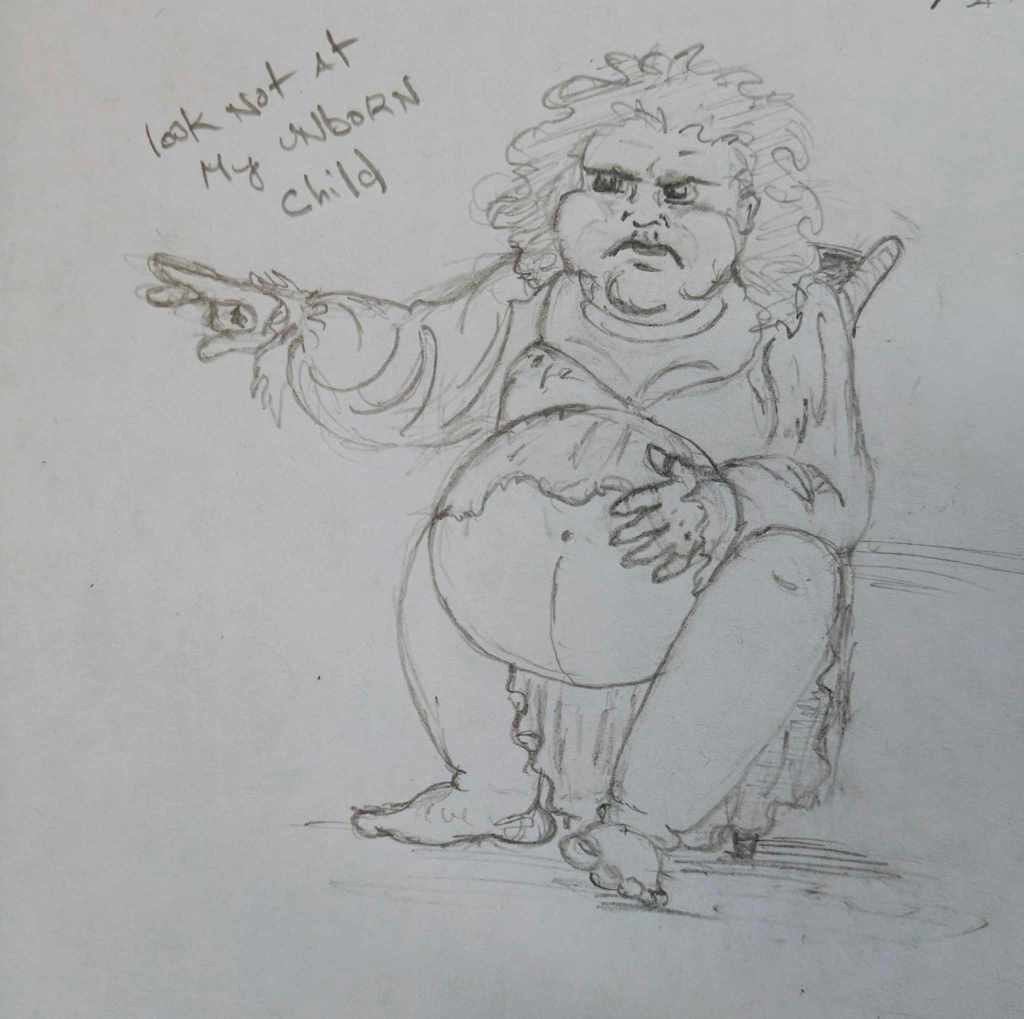
“Look not at my unborn child,” she said coldly, and made a forked warding sign at her. It was a gesture the girl had seen a thousand times and no longer paid any mind. Assuming the evil eye ward counted as a dismissal, she took a step forward. However, the woman was not done.
“What’s that under your arm?” she demanded imperiously. She shifted uncomfortably in her seat, calling to Adisha’s mind the trolls in her father’s stories. If this woman only had a bridge to hide under, she would fit perfectly. Her neck was so fat that she had neither chin nor cheeks; her features seemed simply placed upon the bulbous mass of flesh that rose from her shirt collar. In truth the pregnancy had gone completely unnoticed for months, lost in the rather intimidating folds that grew with each season of prosperity.
Adisha stuttered her answer. “Whiskey from our Lord Esmund to trade.” Wouldn’t this shrew just let her be?
“We’ll have none of your devilry in this shop!” she snapped, as though Adisha had poisoned the cask. “If the Lord loves your father so very much, then ask him to bring you meat! Take your business elsewhere and do not visit your evil upon this doorstep!”
“Nonsense, Limeria!” Messior Attor rumbled from deep within the shop. “Her trade is as good as anyone else’s! Trouble her not!”
Red rushed to the Messes’ cheeks, although from anger or embarrassment Adisha would not venture to guess. Relieved, she dropped her head and hurried through the door into the cool depths of the butcher shop and ran head-long into something tall and firm. It was a man’s chest. She looked up and immediately decided that she would prefer to be back on the porch, receiving barbs from Limeria Attor.
It was Chancel that she had run into, no doubt visiting Mishka.
They stared at each other for a moment and then he stepped back. Holding her stunned gaze, he smiled and bowed, eyes glittering. He winked, then strolled off with his hands in his pockets, whistling a jaunty tune.
Suddenly she wanted to slap him again.
She traded the small cask of whiskey for a modest barrel of salted and smoked pork meat. She had some bear and gator added for variety. So that she would not have to carry it across the village, Messior Attor said he would have one of his young sons drop it off at her door later that afternoon.
On the way out, Limeria could not resist a parting shot. “Charming, isn’t he?”
It took Adisha a second to work out that she was referring to Chancel and the awkward moment at the door. Adisha tried to make her face into a mask and did not respond.
The Messes continued. “That one belongs to my daughter. A pity you’ll never find one of your own.” She smiled sweetly and then looked out towards the river in a dismissal.
A simple blow to the face would have been more civil. Compounded by the scenes in both the swamp and the doorway it hit, cold and sharp, right through Adisha’s chest. But she would not let this woman see the wound she had inflicted. She retreated behind her mask, raising a haughty eyebrow as if to question the logic behind the statement.
“That makes no matter to me,” she replied coldly. How easily the lie fell from her lips, as though the words belonged to someone else entirely! Even though her stony insides seemed to have dropped to her shoes, she made sure her shoulders were square and her head high as she walked away with all the pride she could feign.
The moment in the butcher’s doorway was to prove only the first of the torments which Chancel was now directing her way. Now that he knew her secret, it seemed he was everywhere – around every corner, down every pathway, smiling at her with mockery. She supposed it was punishment for striking him, which she should not have done, but it was a petty and cruel response all the same. If she was working in the garden he was bound to pass by at least once. She knew he was doing it only to bother her, for the cottage was on the edge of the village and he had no reason to go that way for anything. His eyes would fix on her, bright green and glittering. If she was foolish enough to glance up he would smile and incline his head towards her. She learned to keep the road in the corner of her eye and if she saw a pair of man’s boots pass by, she locked her gaze upon her task until he had passed. But sometimes even this did not work. More than once she had seen the boots pause and linger, then move to sit in one of the two garden chairs that flanked the small garden table. He would stay, legs crossed ankle to knee, and whistle cheerfully while Adisha stolidly ignored him.
While going to feed the chickens one morning she was halted sharply in her tracks by a tug that sent the basket of feed flying. The birds went wild, flapping and clucking in their mad pursuit of the grain. Several escaped out the open gate while Adisha turned to find the cause of the trouble. Age and moisture had caused the corner of the little wooden gate to separate, and her apron had gotten wedged tightly between the two edges. No matter how she tugged or pulled she couldn’t get free. In the meantime, three hens were strolling merrily down the pathway.
It was while she was caught in this rather inconvenient predicament that Chancel happened around the corner. Their eyes met and Adisha felt her cheeks heat instantly. He smiled; her violet eyes narrowed and she gave the apron another tug, rougher than she had actually intended. She heard the fabric rip but the apron remained stubbornly embedded in the wood. Crossing his arms and leaning comfortably against the wall of her cottage, Chancel watched the whole scene with amusement shining in his eyes. As the chickens wandered past him, he swooped down and gathered all three up with a grace that made her chest tighten. Holding the birds by their feet, he approached her with that same cocky smile on his face. She gave her apron another yank. Chancel looked like he was about to break into laughter. He came to the gate, standing closer to her than was strictly necessary, and gently tossed the hens inside. They fluttered to the ground in a flurry of feathers. He turned to face her, towering over her for a moment, so close their two bodies were nearly touching. That same damned fire began to heat her insides again, and she tugged at her trapped clothing with renewed vigor.
“You’re just making it worse,” he said quietly, looking down at her through his hair and still – blast him – smiling. “Let me.” He bent down, his body brushing hers just slightly before she pulled away, and fiddled with the snagged fabric for only a moment before his talented fingers were able to release the cloth. He stood straight again. “There,” he said with no small degree of satisfaction. “You are free to go.”
For a moment she did not move at all. They simply stood there staring at each other, his eyes laughing and hers wide. She had to escape. She made a bow, forcing herself not to hurry it too much, picked up the basket, and went back inside, entirely forgetting to collect the morning’s eggs.
After days of the tiresome game of cat-and-mouse, Adisha resorted to the one chore in which she was sure he would not pester her. Grabbing a large, soft basket from the root cellar, she set off for the orchard. Normally she rose with the sun, not before it, but the nightmares had kept her awake again and the cottage felt like a prison. A morning walk and a ripe apple would make her feel right again.
The morning was crisp and chill, the ground still wet from the night’s rains. The village roosters were crowing into the grey dawn. They roamed free, nesting where they wished and getting in with the hens whenever possible. There was a particularly fearsome kaiju known throughout the village as Gran’pere, twice the size of the hens with multiple spurs on each leg and a long, showy tail. It was always easy to tell if Gran’pere had gotten in with someone’s hens because the chicks would hatch with multiple spurs. He also liked to fight, attacking whatever he wished at random, from people to the Attor’s horses. That nasty fellow had been alive for as long as Adisha could remember; aye, many of the villagers swore the kaiju rooster was immortal. He was in her path this morning but thankfully decided to ignore her. He pecked twice at the ground to one side of the dirt road before strutting across, occasionally letting off a crow or two just to make sure everyone knew he was about.
The orchard had been planted long ago by Lord Esmund. It encircled the walls of the castle keep, free for the enjoyment and use of his subjects. It offered them a great variety of fruits: apricots, cherries, and peaches in the spring and summer, and apples and pears for the fall, all growing from the same grafted trees. The trees were hundreds of years old, their short trucks gnarled and their thick, low branches twisted and tough. Some of the trees grew sideways instead of upwards, as if their load had been too heavy and they had simply lain down for a rest. There were days when she, Chancel, and of course Mishka had laid beneath the branches and watched the spring blossoms fall all around them like fragrant snow. In the fall the leaves became a riot of red and gold.
Morning fog gave the orchard an exquisite, ghostly beauty. Twisted branches and curving trunks rose from the mist, row upon row of gnarled, moss-covered wood. The normally vibrant colors of the leaves and fruits were muted and soft. She could just make out the yellow stone of Arlington’s keep walls rising above the trees. Here and there were ladders propped against the trunks. Fallen apples rolled from beneath her feet, their pungent smell filling her nostrils.
Fruit picking was girl’s work. On beautiful days the orchard would be filled with the sound of gossip and giggles as family and friends filled their baskets with their Lord’s bounty. For that reason, Adisha often avoided the place, and when she came she tried to make it earlier than everyone else. Being in the orchard among the girls of the village was often unpleasant; conversation would first lull, then resume in hushed tones. Furtive glances would be thrown her way and the giggling would take on a different manner, ripe with nastiness. Sometimes, when she was high in a tree, she would come down to find rotten fruit had been snuck into her basket. But worst of all was when they would leave. Little by little, the other girls would gather their baskets and move to a different section of the orchard. Adisha wasn’t sure if the shunning was intentional or entirely unconscious, but inevitably she would end up alone, listening to the sounds of friendship and camaraderie echo from other sides of the circular keep, out of sight and utterly unknowable. It was the story of her life.
This dawn she only shared the orchard with the birds that were twittering in the trees. Even Archimedes was not to be found.
The branches were low enough she had to take care to watch her head. Her thick curls were bundled in a bright purple scarf so they wouldn’t become ensnared in the branches; she remembered once as a little girl screaming her head off while Chancel tried to untangle her locks from a tree. She was playing in the top-most part and had gotten so caught up in the branches that she was completely immobilized. In the end he had to pull a stone dagger from his boot and cut her loose. It had taken over a year for her hair to look right again. The whole scene made the episode when he freed her from the chicken coop the other day even more poignant.
She found a tree with a ladder propped beneath and reached as high as she could for the best, ripest fruits. The mist had faded and the fruits’ bright skin seemed too vibrant to be real, glowing in shades of ruby, orange, and yellow like miniature, juicy suns. Chancel used to climb to the very highest branches and drop the fruits down to her, never minding that he was the only boy in the whole orchard.
“I’m picking fruit with the prettiest girl in the village,” he would always say by way of explanation. Mishka, who was never included in this sentence, always wrinkled her nose and stuck out her tongue.
“Why don’t you just marry her then, Chancel?” she taunted. “Chancel and Adisha, sittin’ in a tree…”
Lost in her memories, she barely noticed when other girls began to filter in to fill their own baskets or aprons. The childhood sweethearts in her mind’s eye were more real to her than the village girls in their full skirts and snowy aprons, more significant than the furtive over-the-shoulder glances thrown her way or the wide spaces they gave her. She thought of sitting beneath the trees and sharing a peach with him. Somewhere, someone was whistling.
One tree picked clean of ripe apples and pears, she moved to find another. Conversation always halted when she passed, movement paused, and eyes followed with suspicion until she was a safe distance gone. There was, at one point, a sudden cry of surprise behind her back. She looked behind her to see an overturned ladder and a girl picking herself off the ground, her clothes smeared with grass stains and muck from over-ripe fruits. Adisha snorted. If the silly cow had been paying attention to her footing instead of the village pariah, then she would not have fallen in the first place.
The story was the same no matter which part of the orchard she went to. Three girls were singing together, a little nonsense ditty about flying to the moon and playing amongst the stars, which was often sung at the festivals after everyone had had too much ale and mead. The words faded as she approached. She shrugged it off, chose a ladder and climbed, carefully selecting her fruits and dropping them into the basket. The pears she chose needed to ripen on the dinner table for two or three days, and then she would make a pie before jarring or drying the rest.
The tune of the nonsense ditty continued in her head, the melody light, bright, and swinging. The sound matched the fruit, the breeze, and the swaying branches. While she imagined baking a tart of pear and fresh goat cheese, the girls in the nearby trees gradually melted away to other parts of the orchard. Soon she found herself in a circle of solitude. That was all well and good, really; if another silly girl took a tumble they would surely call it witchery. The song resumed in another part of the orchard and she was soon absently humming along. It made her feel less isolated, a connection to others no matter how thin. Somewhere nearby, the whistler was doing the same tune, and it seemed the orchard was full of music.
When the basket was full she hefted it to one hip. As she passed beneath the low branches, the whistling broke into words and a plump, beautiful pear dropped into her basket. A male voice took up the nonsense ditty, this time singing about springtime in forgotten places called Jupeter and Mars.
She realized who the voice belonged to a trifle before a head of copper hair dropped in front of her. Chancel was hanging by his knees from one of the ancient branches. Startled, she screamed and dropped the basket, stumbling and sitting down hard in the grass. One hand landed solidly on a spoiled pear, the brown muck squooshing between her splayed fingers.
This did nothing for her mood.
He swung backwards once and released his legs, doing a neat half-flip and landing on his feet.
“Chancel!” she cried in aggravation. “The Visitant Lords and Dead Gods damn you!”
“Sorry ‘bout that,” he replied, but the chuckle in his voice suggested he was anything but. Adisha hastily wiped her hand on her apron and began gathering the spilled fruit. He crouched to help and started whistling again.
“Why do you insist on tormenting me?” she demanded, tossing a mix of apples and pears into the basket.
“Can’t a fellow enjoy a pleasant morning in the orchard without being accused of torment?”
She paused and made a face at him. A few curls had escaped from her scarf and hung in her face. She tucked them behind an ear and continued to pick up the spilled produce.
“Leave me be, Chancel,” she sighed. “I would rather be alone than trust in your company only to lose it again, and soon.”
“Why are you so sure that I’ll not continue to offer you my friendship?”
“Married men do not have female friends.”
“I’ll do as I please.”
“As you have for the past four years?”
It was his turn to sigh. “Adisha, that’s not fair. I told you what my pa’pere would have done to me.”
She could not argue that, remembering the vivid bruises on his face.
And yet it still hurt.
She shrugged, dropping the last three pears into the basket and standing.
“You are not your own man,” she sighed. “You belonged to your father and soon you shall belong to Mishka. What we had as children is past and buried. I wish you would leave it there, and leave me to my solitude.” She held his gaze meaningfully for a moment, then dropped her head and shouldered past. He side-stepped and blocked her, putting his hands on the handles of the basket, over hers. The fire inside her lit again.
“I do not believe you wish me to, not the one nor the other. You pretend you hate me, but I know better.”
“I am not the girl you once knew,” she snapped, pulling away. “And I’ll not be some secret, last minute conquest before you promise yourself to another, either, so I suggest you quit touching me. The days of us sneaking into the swamp are long past.”
“Very well,” he said, raising both hands in a gesture of surrender and stepping away. That damned smiled returned to his face and he bowed. She nodded at him in return and began to walk. Suddenly he darted in front of her, snatched a ripe apple from the top of the basket and tossed it high into the air before catching it and taking a bite. He winked, turned on his heel and walked off, whistling merrily.
If both her hands hadn’t been full, she would have thrown a pear at his head.
The days cooled and the nights lengthened. Harvest wreaths and garlands began to appear over doorways. The village girls now spent their evenings giggling on their porches and door stoops, making their harvest crowns for the upcoming festival. The fields were cleared day by day, until finally, the golden wheat stood propped in neat bundles throughout the cropped fields and the corn was piled in great wooden crates. Chancel had ceased his teasing, but Adisha suspected it had nothing to do with the wishes she had expressed in the orchard but instead a result of the onslaught of jewelry orders. He was at his workbench from dawn to dusk, laboring over lovely works of wood, wire, and stone. Beneath his talented fingers grew torques of shining, polished wood inlaid with fine strands of steel wire and capped with polished stones. Hoops of braded metal and necklaces of elaborately woven glass or stone beads glinted in the sunlight as he produced one after the other, spread out on soft leather or hanging from wooden-pegged displays. The villagers traded heavily for them, bringing him butter, fruits, meats, and wares. He was one of the few in the village who never need lift a finger in field or garden to eat well.
However, nothing more was seen of the beautiful pink copper that had created such a stir, or the delicate knot-work ring which he had fashioned from it. When the metal was requested for a custom order, he simply shrugged and said it was unavailable.
*3*
The Festival was to begin at twilight. Torches lined the path to the town square, casting flickering shadows that made the harvest garland draped over the split-rail fence seem to dance. Jack-o-lanterns sat on every fence post, grinning their candlelit, toothy smiles. Within the square, three long banquet tables had been formed into a “U” shape and draped in expensive, bright red cloth and colorful harvest garland. One table was for the Autumn Brides and the men they were to wed this night; the other for the Autumn Bachelors who were to announce their intended brides following the nuptials. The center table was heavily laden with the feast. Turkeys, geese, chickens, a roast pig with an apple in its mouth, and a variety of fish and eel glimmered in the firelight. Berries, nuts, and herbs decorated their serving plates. A mountain of rolls sat piled high in a large basket. Next to it was a large globe of butter shaped into a jack-o-lantern and filled with nuts. There were five different kinds of cheeses arranged into pyramids and wheels, and best of all was the seasonal gift from Lord Esmund, a three-tiered chocolate cake drizzled in thick syrup and crowned with fat raspberries. Chocolate was a rare treat for the villagers; trading for it was costly if one could even find a merchant that carried it. Such luxury came only from the Lord as gifts for the Autumn and Winter Festivals. Spring and Summer, on the other hand, brought light, sweet white cakes.
Smaller tables draped in orange sat scattered about the edges of the square, and in the center of it all stood the pyre for the season’s bonfire. It was not yet lit; the logs leaned against each other to twice the height of a man. As they entered, the villagers cast their harvest charms – small bundles of wheat and hard corn – onto the pile to bring them luck through the winter.
Made of the same green material as the Melted Lady, this statue also bore scars from the poisonous Fourth World fires. Yet still the subject’s countenance was so regal, his posture so proud, that it was impossible not to imagine he had once been a great lord of some sort. The nose was smooth and hooked, the mouth thin and severe, the brow slightly furrowed as though concentrating on something serious. His chin was raised, his shoulders straight. His hair was curled at the ears and tied with a ribbon at the nape of his neck. He wore a jacket with a high collar and a scarf wrapped stock-wise around his neck, and atop his head was a hat with three corners. Even now he looked into the distance with expectation. He was astride a magnificent horse who looked forward with equal expectation, ears pricked, mane flowing forward as though he had just stopped short. Many called the statue The Drowning Rider, for everything below his hips was buried beneath the earth. Adisha, however, saw just the opposite. To her, the statue was an object of perpetual motion, endlessly rising from the grassy field as though he had just finished dashing out of a river or lake. As a little girl she had always rushed to the square in the mornings to see if he had emerged. Although of course he never did, her impression of him remained with her even into adulthood. Tonight, his shoulders had been draped with garland. A Harvest Wreath was placed upon his brow and another about the neck of the horse. Before him were small Harvest trinkets, dropped as tribute to Fourth World and the Dead Gods. Adisha and Bertrand paused to drop their own tokens before the statue. She took a moment to look into the distant eyes of the man. He had been as constant a presence in her life as the Melted Lady, yet she had never dared touch him. He was a relic of Fourth World, and she did not wish to have a screaming vision in the very heart of the village.
Heart heavy but head high, Adisha walked into the square on the arm of her pa’pere. Bertrand carried himself with a pride uncommon in the village, more like one of the Lords than one of the humans. His harvest crown of wheat shafts sat atop his silver hair as though it were a precious thing of gold and gems. Gold rimmed spectacles of remarkable age – a gift from The Lord to compensate for his fading vision – glinted in the firelight. Soft, flowing white sleeves extended from a fine leather vest adorned with carefully carved bone buttons. Brown leggings were tucked into leather boots that rose to his knees, the envy of many in the village for they had real metal buckles instead of plain laces. The position of Lord’s Book Keeper had long and strange hours, but many benefits.
Adisha also wore one of those benefits – a frock of bright crimson. The neckline was wide and low, riding midway down the roundness of her shoulders and displaying her delicate collar bone and the gentle slope of her small breasts. A red glass bauble dangled between the pale mounds, suspended from her neck on a leather thong. A row of small buttons traveled down the front of the dress to where the skirt ended midway between ankles and knees. Slim sleeves buttoned at the wrists. Although it did not display her violet eyes to their best effect, she loved the dress all the same for it drew looks of longing and envy from the other ladies in the village, who could only dream of possessing a garment that was made entirely of that coveted, rare color. The village hens may not have allowed their children to befriend her, but at least they would never own a dress such as this! Indeed, the red table cloths on the three main tables were kept under lock and key by the Lord himself!
Still, neither the dress nor her harvest crown brought her much comfort when she saw Chancel sitting at the Bachelors’ table. There were four other boys seated with him. They laughed and joked with each other while they waited for the nuptials to begin the event. She unconsciously squeezed Bertrand’s arm; he put his hand on hers and looked down at her.
“Is something the matter, piccola?”
Adisha shook her head. If Bertrand were to understand the depths of her isolation it would only add further worry to his already worn face. He was confident that his beautiful daughter would wed; she, on the other hand, knew very well that this was only slightly more likely than the possibility of waking up one morning and seeing the Drowning Rider and his mount standing free from the earth.
The square filled and the musicians arrived, taking position in a corner. They struck up a lively tune with their tambourines, drums, and wooden flutes and people began to dance. Adisha sat next to her father and watched the villagers whirl. The men had ribbons tied around their elbows, the women had them in their hair and at their wrists. The swirling fall skirts in their bright harvest colors made them look like autumn leaves caught in the wind.
After a few dances a horn blew. It was a beautiful thing, cut from the head of a marvelous bull many centuries ago. Marbled black and cream, it was tipped with actual silver and was as long as a man’s arm. Its polished surface shone in the torch light, and the note it produced was long and low. Simon, great grand-son of Archer the Eldest, forced the call with practiced ease. Archer himself leaned on a gnarled walking stick nearby. The music stopped and the dancers moved to sit at their tables. Every face turned towards the entrance. There stood the wedding couples, three pairs of them in an orderly line with the brides on the right. Each boy had announced his intended bride-to-be at the seasonal festival which marked his eighteenth year, and they now waited to be wedded at this, their brides’ birth feast.
All six of the happy couples had once been Adisha’s playmates.
All six had ultimately shunned her.
The boys wore beautiful leathers in various shades of brown. Elegant and close-fitting jackets were decorated with laces or buttons of bone or wood. They were cut away at the front waist and swooped down in the back to the knees. Fresh white shirts peeked around the leather. Fine warm cloaks of fur hung around their shoulders. They all looked very handsome, even short and chubby little Theodore.
The brides, however, were best of all. They wore long white dresses of delicately woven cotton in various styles, accented with embroidery, ribbons, and lace in white and harvest colors. Wide sashes with trailing ribbons encircled their waists. Ribbons and glass bells dangled from their harvest crowns.
A second blast on the polished horn brought the party to their feet and the Nuptial Procession marched in to the slow beat of a single drum. Each couple paused in front of the pyre and added their Nuptial Charms to the pile. The bright ribbons with which they were wrapped contrasted the simple rope which bound the smaller Harvest Charms. After this pause they proceeded towards Archer Eldest, who stood crooked but proud in front of the banquet table. Solemnly they fanned out before him. The drum ceased. There was not a whisper while they waited for the Eldest to begin.
“Comrades,” he said. The traditional speech had been committed to memory for a great many years. His voice was rusty and gruff with age. His long silver beard quivered with the words, making the numerous steel and glass beads braided into the coarse strands glitter with each syllable. His walking stick was polished to a shine from years of use. It was rumored that Archer was well over a hundred years of age, but no one knew for sure, including The Eldest himself.
“We join tonight to celebrate the changing of the seasons, and with it, to celebrate a new season in the lives of our children. As summer transits into autumn, we shall witness here with joy the joining of two hands, two hearts, two bloods, into one. Edward and Atlanta, Theodore and Juliet, and Herschel and Marianne all leave their childhood as individuals and step into adulthood as one.” Archer looked at Edward, closest to his right. The couples were positioned from right to left according to the age of the brides, and Atlanta was seventeen and the oldest.
Edward said to her, “Atlanta, daughter of Samuell Jacobs of Wash, soon to be my wife, I pledge from this moment on to keep you and protect you to the best of my abilities and beyond. Wear this cloak, which I have hunted and sewn, as a symbol of my promise.” Holding her gaze, he reached for his throat and unfastened the knot that held his fox-fur cloak around his shoulders. With a flourish he twirled it off and placed it gently on his bride’s shoulders. Then it was Theodore’s turn to make the oath and cloak his own bride, which he did without the flourish, and finally came Herschel, who fumbled nervously with the tie before accomplishing his goal.
When the trading of the cloaks was finished, Archer turned towards a carved wooden dais which dominated the center of the banquet table. He took three small torches from their place in front and handed them to each bride in turn. He then took the seasonal candle from the center of the dais. Colourful autumn leaves had been pressed into its surface. He looked at Atlanta, who said to her mate, “Edward Thatcher of Wash, soon to be my husband, I pledge from this moment on to keep you and care for you, to the best of my abilities, and beyond. Let this torch symbolize the warmth of our hearth, the warmth of our bed, and the warmth of our hearts, now and forever.” She lit the torch from Archer’s candle. Juliet and Marianne repeated the ritual, and when all three were lit, Archer said, “Let the fire of your love warm us all this Solstice Eve.” The brides turned from Archer to face the pyre. In time with each other, they thrust their torches into the base. The pitch caught and the pyre ignited with a throaty whoomp.
Now Archer held out his hand and Simon put into it a bone-handled dagger. Set into the bone was Lord Esmund’s seal – a sword crossed over a book. The dagger belonged to him and symbolized his blessing over the unions. Unlike the crude stone knives of the villagers, this blade was made of fine, whorled steel. Archer lifted it high above his head. “The oaths have been sworn before all here today. From this moment on, no man may tear these sacred vows asunder. And now, with the melding of the bloods, two will become one.” He lowered his hands and passed the knife to Edward. Edward took the dagger in one hand and took his bride’s in the other.
Atlanta said, “I trust you, Edward Thatcher, with my life’s blood. Make the mark so that we may become one.” She grimaced gracefully as he made the shallow cut across the lines of her palm. Then they swapped positions, and he repeated the sacred phrase. With their life fluid beading on their palms like wet jewels, Archer placed their hands together and tied them with one of three Harvest Ribbons he wore around his neck. Then he cleaned the dagger on a soft piece of whiskey-soaked leather and passed it solemnly to Herschel, and the ritual repeated. When the couples were all three cut and bound, Archer once against cleaned the knife and anointed it in clove oil before passing it to Simon, who silently slipped it back into its ray-skin sheath and put it in its place of honor on the raised dais.
It was time for the old man to complete the ritual. “You shall now stay bound to each other, first until the sacred Seasonal Candle burns out and then symbolically for all eternity as husband and wife. May the Lords and Dead Gods smile upon you all and bless you and your offspring for all time. Let the feast of the Harvest begin!”
Thunderous applause rose as the newly-weds threw their bound hands into the air. The musicians renewed their jangle with vigor. Archer tapped the huge cask of mead and made the first cut of the roast pig, his honor as Eldest. The couples lined up to serve each other their first meal as one unit. Once they were seated, Chancel and the other Autumn Bachelors would serve themselves, and then the banquet table was open to the general revelers.
Adisha generously filled two wooden plates, piling her pa’pere’s plate so high that it nearly tumbled from her fingers when she was jostled by a dancing villager. Several female younglings kept the men’s flagons and wine-horns full of mead as was their duty on the celebration of their tenth season. But save for the company of Archer, no one bothered to sit at the table she and her father shared. Bertrand was animatedly discussing a great number of complex things with The Eldest and seemed either not to notice or not to care that no one else joined them. Bertrand had learned a great many things from Lord Esmund, and Archer was the only one in the village who seemed able to offer him engaging conversation. For her, however, the shunning stung. Especially tonight. Something which had long ago become merely an annoyance was salt in the wound as she watched Chancel’s beautiful hair glimmer in the light of the bonfire. That which kept their table empty tonight was the same that kept the two of them apart. He threw his head back and laughed at some joke, and the wound burned hotter.
Bertrand and Archer argued the policies and philosophies of Esmund and various distant Lords. Adisha heard the words but cared not for politics. It was neither a woman’s place nor a mortal’s.
Mead flowed. Villagers danced, whirled, laughed, kissed. The newly-weds twirled in each other’s arms, drunk on mead and each other. Younglings chased and hid beneath the cloth-covered table, making her ache further. She and Chancel used to do that, too.
The moon traveled across the sky and the Autumn Candle burned halfway down; when it went out, the new couples untied their bonds and the Autumn Bachelors would announce their future brides.
The Attor family table was crowded; everyone wanted to dine with the prosperous butcher and the much anticipated almost bride. Mishka was radiant. She may not have had Adisha’s beautiful red frock, but she was well-flattered in a full skirt of deep gold and a finely made brown leather corset that had cost her father a whole fattened hog. The lace on the flowing sleeves of her thin white shirt was made of silk and had been brought from a far distant lordship. Her brown hair was curled and her harvest crown bedecked with ribbons and beads. She wore her mother’s second finest necklace, a bib of delicate chains and dozens of golden glass beads that rose high on her neck like a collar and descended in ever widening swoops. She was a far cry from the little mouse she had always been. No, tonight she twirled and giggled and spun with the other girls, throwing her head back and tossing her hands in the air as the night grew wilder. She kept an eye on her anticipated beaux the whole time, never moving too far from the table and taking care that every movement was as graceful and – as she continued to quaff mead – as sensuous as possible. Chancel watched her now and again with a gleam in his eye, but not once did he move from the table except to get food, even when she beckoned him to dance with her. The invitation itself was daring and bold as women did not do such things, but she was not perturbed by his refusal and simply spun away, giggling.
Bertrand and Archer had tired of politics and had commenced discussing the centuries-past Visitant Wars. It was a topic Adisha had heard them discuss so frequently that she only paid minimal attention to the conversation now; she was sure that she knew almost as much about it as they did. She had, after all, grown up hearing the stories at her father’s knee or tucked into her warm bed nook while he and Archer talked late into the night. Many times, had he recounted for her the great acts of their noble and brave Lord Esmund. She knew well how, following the Fourth Dermanenlion the world had descended into darkness as the human survivors struggled to stay alive. Not all of the Visitants respected their task of protecting the humans, some instead turned upon their wards, glutting themselves on the blood of the survivors and multiplying until humanity, already sick and dwindling, was run nearly into extinction. Facing starvation themselves, the Visitants then turned upon each other. Out of this chaos rose a Visitant named Esmund Garrett. He, and others like him, respected the will of the Dead Gods and fought against the extinction of humanity. For centuries the Visitant Wars raged, and when it ended Esmund Garrett and his allies had been victorious. They struck down those Visitants who would not obey the will of the Dead Gods, formed a council, and established the current world order by dividing the devastated world between them and establishing lordships. They offered care and protection to their human wards in exchange for their loyalty, their labor, and their kaiju, which sated the Visitants’ need for blood while relieving the humans of the burden of their care. Under the watchful parentage of the Visitants, humanity grew and civilization rebuilt.
Her pa’pere’s wine horn lay on its side in a puddle of its contents for he had moved on to the whiskey in his hip flask – the two men were sharing it and slurring, arguing and clapping each other on the shoulders and they had returned to politics, discussing rumors of the policies of the other Visitant Lords. The dancing grew wilder, closer. Hands slipped higher or lower than propriety strictly allowed and now and again a couple would disappear into the night. A small boy ran up to Adisha, who had not moved from the table for some time now, stuck his tongue out at her and wiggled his fingers in his ears before dashing off.
It had probably been a dare. Go tease the witch or you’re a chicken!
She was done. Grabbing her father’s wine-horn, Adisha threw her head back and made her way to the cask of mead. She rarely drank, but she felt as raw as a skinned rabbit and was sure that if she didn’t do something to steady her nerves – and her growing temper – that she would scream and walk out before the candle had burnt down, and that would be scandalously rude. She filled the horn once and drained it in a smooth gulp of sweet, golden fire without even turning from the spout, and began to fill it again.
A voice in her ear startled her so badly she dropped it and the beverage spilled onto the grass. “Care to dance?”
Although she knew the voice as well as she knew her own, it still shocked her to look up and see Chancel’s emerald eyes just inches away. Her lips parted in surprise, but the request was so absurd that she could not begin to conjure a response.
He answered for her. “Of course you do!” Without a moment’s hesitation he had taken her hand and whirled her into the autumn-colored mélange of revelers. He was head and shoulders taller than she and easily twirled her beneath one long arm before spinning her against him. She heard a few gasps as people realized what was happening: the village’s most anticipated Autumn Bachelor was dancing with someone other than who was expected, and not only that, but with the witch! With the heretic! With the Cadilari! He spun her away and back again and she felt her cheeks redden as she was pressed against his body.
“Chancel!” she gasped, “What are you doing?”
“What does it look like? I am dancing with the most beautiful girl in the village.”
“But… but Mishka! Your bride! This is scandal!”
Another twirl. “What scandal? I have not yet announced her. Just because everyone expects me to does not mean that I am not free to dance with whom I please. The fire has not yet burned down. I am still my own man.”
“But people will talk! You’ll damage your reputation to dance with me!”
“Fie!” he cried with a laugh, and spun her into him so roughly that her harvest crown was knocked askew. “You were my best friend! I have been forbidden your company for the past four years by my father and denied it this late season by your righteous anger, but I will dance with you this night until the fire burns low, and the rest of them be damned!” His joy was positively infectious. She gave in and they twirled together like a top and finally she threw her head back and laughed as perhaps she had never done before. The drums seemed to become wilder and the mead began to take hold of her head. As they spun and dipped, she caught sight of Mishka, who was sitting down for the first time that night and had retreated behind her hair, again the mouse. Her mother, however, was flushed red with fury. Damn it all! They hated her yesterday, they hated her now, and they would hate her in the morning. This was likely the only dance she would ever be given, and she was going to enjoy it!
Enjoy it she did. For the next few hours they spun, they laughed, they drank, and she forgot the ache in her heart. The years of silence and betrayal slipped away and they were younglings again, utterly care-free. She forgot that she was shunned and feared, for with him now and always it seemed they were the only two people in the world.
But the Seasonal Candle eventually winked out, and Simon blew the horn. Chancel parted from her – it hurt like drawing a splinter – bowed low, and kissed her hand. “Please forgive me,” he said gravely, looking deep into her eyes with the same expression that he had worn when his pa’pere had drug him away, that wonderful/awful day in the swamp. “I must go announce my bride.”
Even though she had known it was to come, the words were still a blow. She tried to push away the heaviness that pulled her head towards the earth, tried to ignore the look of relief and victory that rose on Mishka’s face. Mishka would not mind that Chancel had danced with the witch for one night; in just a few short minutes he would be hers for ever more. But Adisha would not grant the little mouse nor her hateful mother the satisfaction of seeing her agony. You’ll get over it, she told herself, and forced her head upwards. With a strength she didn’t know she possessed she walked proudly back to join her father. She painted a pleasant smile on her face and sat with her hands in her lap and her ankles crossed, the perfect lady. They would never know she was dying on the inside.
You’ll get over it.
Archer had returned to the banquet tables and a hush fell over the now-inebriated villagers. The newly-weds fanned out in front of him, their hands still bound in the bright ribbons. He raised the melted stump of the candle into the air. “The Autumn Candle has burnt out! The blood has melded!” Each couple held their bound hands to him. He said to each, “I now free you from these physical bonds that you may lead a productive life, but the symbolic bond between you may never be broken.” The couples responded with, “So mote it be!” and he untied each in turn. When all were free, they raised their hands in the air, displaying the wounds with pride. “I now pronounce you man and wife! Go forth and multiply!” There was great applause and the musicians began again. The couples had marched in to the solemn, steady beat of a single drum, but now they danced out of the square to the merry cacophony of tambourines and flutes, disappearing into their new homes to tuck their ribbons into the ticking of their mattresses and consummate their nuptials.
Once they had gone, the horn blew again and the music halted. Archer once again raised his voice. “The seasons continue, and so do we. We have here tonight five Autumn Bachelors who are celebrating their eighteenth autumn here tonight. It is tradition that these young men announce the brides they intend to take, that they may begin their journey into the next season of their lives. Young Marcel Wallace of Wash, whom do you choose to be your bride?”
Marcel, who had once been a part of the Midnight Society, stood. “I, Marcel Wallace, take Annette, daughter of Jamir Jackson of Wash, to be my bride this coming Summer, the fifteenth season of her birth.” He held his hand towards a small blond who had joyed in pulling Adisha’s hair and calling her “witch.” She rose, all blushes and smiles, and came forward to join him at the table. They shared a drink from the horn in Archer’s hands and he announced, “Then let you be most joyously wed this coming summer, the fifteenth season of your Bride’s birth!” The crowd applauded and cheered. Archer continued. “Young Albert Prospero of Wash, whom do you ch0ose to be your bride?” Albert had spent a summer following Adisha around asking if she would hex his older sister for him, but she insisted that she could do no such thing. When the sister had in fact fallen ill and died, fingers had pointed at the innocent girl, and the first of them had been Albert’s.
“I, Albert Masuka, take Rosa, daughter of Frederick Ayano of Wash, to be my bride this coming winter, the seventeenth season of her birth.”
Rosa had, in a fit of childish jealously, smeared Adisha’s new white apron with mud and pig shit because she wanted a new one of her own.
Again, the girl joined the boy, and again, they drank.
It was Chancel’s turn. Adisha wanted to run but felt rooted to the spot. Worse than the heartbreak she was fighting was the mingled anger; not so much at him but now at herself, for being unable to stop caring.
Stop! You’ll get over it!
“Young Chancel Fallare of Wash, whom do you choose to be your bride?” Each word brought her a new level of agony.
You’ll get over it!
She could not look at Mishka; the girl’s expression would surely be the blow that killed her.
You’ll get over it!
She could not look at Chancel. She couldn’t. If she did, then surely the world would crack apart.
YOU’LL GET OVER IT!
She looked at Archer, at his craggy, weathered face, at his long, grey hair. The wrinkles and pits made his face look as though it were limestone and not flesh. How many seasons had he seen? How many wives had he buried in his long years?
You’ll get over it.
“I, Chancel Fallare, take Adisha, daughter of Bertrand Corvin of Wash, to be my bride this coming winter, the seventeenth season of her birth.”
There was a moment of utter disorientation when Adisha was sure that she was living in a different world. She had not heard correctly. She stared at Chancel, mouth open in a most un-ladylike manner. A shocked murmur washed through the crowed before the villagers remembered decorum and applauded, quietly, slowly. Bertrand leaned over and kissed her on the cheek and enthusiastically patted her hands, but she barely felt it. Was this some sort of sick joke? How dare he toy with her like this! If she was ever able to find her legs and stand, she would not merely slap him for his mockery; she would full-on punch him! Yet Chancel’s face betrayed no humor. He stood, tall and beautiful, his arm held out to her. There was no hint of a smile. Bertrand nudged at her back.
She reached him and he took her hand in his. She could not feel it; she could not feel anything, not even the ground beneath her alien feet. She expected his face to break into that infuriating smile and for him to laugh and say, “Just joking!” but he didn’t. Instead, he whispered, “If you’ll have me, that is.”
Adisha blinked at him for what felt like years, then nodded mutely. It seemed like such a silly question! Now he smiled, and there was neither cockiness nor mockery in it, only joy. He kissed her hand, and with that kiss feeling returned to her body.
The horn was pushed into her hand and she found herself drinking from it. It was the sweetest mead she had ever tasted. She did not hear Archer’s words, nor the proclamations of the other two boys. She did not notice the brides-to-be as they joined the table. She did not notice the naming ceremony, where the newborns were presented at their first festival and given names before the Dead Gods. The only thing that existed was Chancel’s left hand tight on her right, and the feeling that all this was a dream from which she would wake. Then the horn blew again, the music resumed, and the mead flowed. The celebration would continue until the bonfire turned to embers and it was only halfway down. Somehow, she and he were now dancing, even closer than they had been before. One talented hand was at her back, pressing her against him, and the other held her hand to his chest while he looked down at her, all copper hair and green eyes. They swayed and turned, slowly this time although the drum beat was wild. It was less a dance and more an embrace. Finally, she found the ability to speak.
“Chancel, what are you doing?” she asked for the second time that night.
“What does it look like? I’m marrying the prettiest girl in the village!”
“But Mishka…!”
He laughed. “It was never Mishka! Everyone just assumed it was her, and I let them!”
“Of course they did! The two of you were rarely seen apart!”
“She followed me everywhere, like a pup. It didn’t bother me. She has always been there, but I have never regarded her as more than a friend, and never considered anyone but you for a wife.”
“But… but why didn’t you tell me?”
“I did try, Adisha, but you slapped me. You assumed, too, and you of all people should know better!”
“Ass.” She made a face.
“Really that would be you and all the rest of the village for assuming,” he winked. “Now, I have something for you!” He reached into his pocket, producing the copper knot-work ring he had been working on. It matched his hair perfectly. He slid it onto her finger. “I would never make this for anyone but you.” She looked down at it, stunned again. It glimmered on her finger, somehow a perfect fit. She could think of nothing that was a better symbol of him. Then his finger was on her chin, tilting her face upwards. He kissed her. It was even more wonderful than the one they had shared in the ruins, for it held no shyness, no hesitation. This kiss was not the kiss of timid children trying it for the first time – it was an adult kiss, one of fulfillment, of promise, of anticipation, of love. Their lips met and parted again and again as the music vanished and the world dropped away. There was only the two of them, only the warmth of their mouths and the feel of their bodies pressed against each other, his solid, hers soft. When they stopped, both were breathless and dizzy.
“Wow,” he whispered, putting his forehead to hers and looking down at her. “I can’t believe I let so much time pass between those!”
“Let’s not let that happen again,” she whispered back, leaning up for another.
“I intend to.”
Now he twirled her, picking up rhythm to match the drums. As they danced, she caught sight of Mishka, whom she had temporarily forgotten existed at all. Except for two bright red spots on her cheeks, the girl had gone pale beneath her tan.
“I think steam is about to come out of Messes Attor’s ears,” Chancel commented with a wicked smile. “The greedy bitch. All her wealth isn’t enough – she wanted a rich husband for her daughter. Let her stew!” A laugh escaped Adisha’s throat, not one of victory or vengeance but of happiness bubbling over. They would be wed! He joined in her laughter and they spun together until they were dizzy, and when they could spin no more, they toppled onto the grass in a heap, laughing and watching the festivities heel and tilt around them. Then he rolled onto his elbows and leaned over her, kissing her again. This kiss was different from the previous two, for it was deep and hot and full of an urgent need. He pulled away, breathless. “Let’s get out of here,” he whispered.
“Yes!”
He pulled her to her feet and they regarded each other for a moment, as if memorizing the sight of the other in the light of the bonfire. Then slowly, hand in hand, they walked from the square, trading firelight for moonlight and leaving the wild drums behind. The sound of the revels were carried on the wind so that the rhythm and shouts followed them almost all the way to the swamp. It was joined by the sounds of the summer’s last crickets, the songs of the owls in the trees, and the trilling of the frogs along the riverbanks. It wasn’t until the swamp’s dense foliage closed upon them that the sounds of the festival finally dropped away. There had been no conversation on this long walk, just a silent, pleasurable anticipation of the future, both immediate and more distant.
Then Adisha socked him in the shoulder.
“Tag!” she cried. “You’re it!” She took off, racing through the Cypress and disappearing into the darkness before he even realized what the game was. The swamp swallowed her almost immediately, for it was as familiar to her as the village. Chancel, on the other hand, had been long away from its embrace and was immediately lost in the darkness.
“Adisha?” he called. “Where did you go?” There was no response. The swamp was eerily beautiful. The full moon crept through the trees and dotted the scene with milk-colored light. Crickets and cicadas sang the last of their summer songs. An owl hooted peacefully near-by. But the girl was nowhere to be seen. He stepped carefully through the trees, minding the dense roots that rose from the ground like stiff fingers. Here in the swamp, away from the bonfire, the night was cool but his blood was high. He could feel heat rising from his collar.
“Adisha?” Only the owl responded. He wandered left and right, trying to make out vague shapes, looking for something that could have been a female. There was a flash of red, a whisper of skirts. He hurried forward and reached out but she had disappeared with a giggle “Adisha? Come on out.” He crawled over a fallen tree, searching the shadows. Then a hand was on his shoulder. She turned him and was kissing him, forcing his head down towards hers and demanding from him every ounce of the passion she gave. He pulled her tight against him, so tightly that she couldn’t breathe and then they tasted blood, but from whose lips it was impossible to say. The kiss could have lasted for a minute or an hour; they did not know and it did not matter. Then she broke away, disappearing again into the swamp and forcing him to give chase through the dense vines and moonlit trees until he found himself suddenly beneath the ruined dome. The girl was laughing, peeking at him from behind the melted statue (Leber-tee, she whispered to Adisha, as she had many times in the past). Chancel smiled and went to her, taking her again in his arms and covering her mouth with his. The kiss deepened and they went to the thick moss. And it was there, beneath the dome, beneath the passive gaze of the Melted Lady, that they entered the next season of their lives together.

